





HomePortfolio

Portfolio Archive | Page 3 of 3 | Texple

Globally incubate standards compliant channels before scalable benefits. Quickly disseminate superior deliverables whereas web-enabled applications. Quickly drive clicks-and-mortar catalysts for change before vertical architectures.

Blogs

Globally incubate standards compliant channels before scalable benefits. Quickly disseminate superior deliverables whereas web-enabled applications. Quickly drive clicks-and-mortar catalysts for change before vertical architectures.
bt_bb_section_bottom_section_coverage_image
The Future of DevSecOps: How AI is Enhancing Security in Software Development
Introduction In today’s fast-paced software development landscape, security can no longer be an afterthought. DevSecOps (Development, Security, and Operations) integrates security into every phase of the software development lifecycle (SDLC), ensuring that applications are secure by design. However, traditional security practices often struggle to keep up with rapid development cycles, leading to vulnerabilities and compliance...
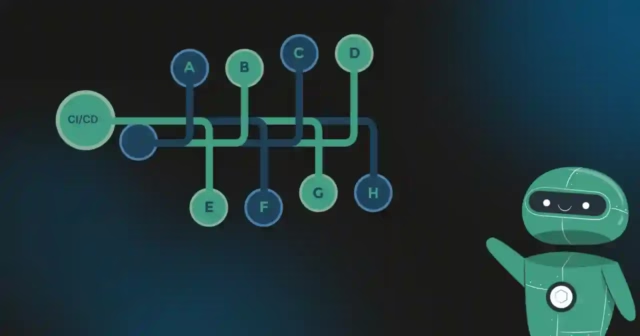
AI in DevOps: How AI is Revolutionizing CI/CD Pipelines
Introduction In modern software development, Continuous Integration (CI) and Continuous Deployment (CD) have become crucial for automating builds, testing, and deployments. However, traditional CI/CD pipelines often suffer from inefficiencies like slow builds, flaky tests, security vulnerabilities, and manual interventions. With the integration of Artificial Intelligence (AI) and Machine Learning (ML), DevOps teams can optimize their...
Building Smarter Web Applications with AI and Machine Learning
Introduction Web applications have evolved significantly with the integration of Artificial Intelligence (AI) and Machine Learning (ML). AI-powered web apps provide personalized experiences, automation, predictive analytics, and intelligent decision-making. From chatbots and recommendation systems to fraud detection and image recognition, AI is reshaping how web applications function. This blog will explore how AI and ML...
AI-Powered Web Development: How AI is Automating Frontend and Backend Development
Introduction Web development is evolving rapidly, and Artificial Intelligence (AI) is at the forefront of this transformation. AI-powered tools and automation are revolutionizing both frontend and backend development, making web applications more efficient, scalable, and personalized. From automated code generation and AI-powered UI/UX design to intelligent backend management and security monitoring, AI is reducing the...
Top Mobile App Development Trends in 2025: AI, 5G, and Beyond
Introduction The mobile app development landscape is evolving rapidly, with AI, 5G, blockchain, AR/VR, and edge computing shaping the future. In 2025, mobile applications will be smarter, faster, and more immersive, providing users with hyper-personalized experiences and seamless connectivity. From AI-driven chatbots and real-time video streaming with 5G to blockchain-based security and AR-powered shopping experiences,...
AI in Mobile Apps: How Machine Learning is Transforming User Experience
Introduction Artificial Intelligence (AI) and Machine Learning (ML) are revolutionizing the mobile app industry, making applications smarter, faster, and more personalized. From voice assistants and predictive text to real-time language translation and AI-powered recommendations, machine learning is enhancing the way users interact with mobile apps. With GPT-4 and beyond, AI-driven mobile applications are providing hyper-personalized...
Best Practices for Building AI Chatbots That Feel More Human
Introduction AI chatbots have transformed customer interactions, business automation, and digital experiences. However, many chatbots still feel robotic, impersonal, or frustrating due to a lack of emotional intelligence, contextual understanding, and natural conversation flow. The key to success is making chatbots feel more human-like by enhancing their ability to understand emotions, adapt responses, and engage...
How Chatbots are Evolving with GPT-4 and Beyond
How Chatbots are Evolving with GPT-4 and Beyond Introduction Chatbots have transformed the way businesses and individuals interact with technology. From simple rule-based bots to advanced AI-driven conversational agents, the evolution of chatbots has been remarkable. With the advent of GPT-4, chatbots have reached unprecedented levels of intelligence, fluency, and contextual understanding. But what’s next?...
Configuring Zabbix for Endpoint Monitoring on an Endpoint
In this blog post, I’ll walk you through the steps to set up Zabbix for endpoint monitoring. Zabbix is an open-source monitoring solution that helps in tracking network and application performance, and it’s ideal for monitoring endpoint servers. We’ll be hosting it inside an AWS EC2 instance, configuring the installation, and then setting up monitoring...
AWS Landing Zone & AWS Control Tower: A Complete Guide
Introduction As organizations migrate to the cloud, managing multiple AWS accounts and ensuring consistent governance and security can become a complex task. AWS provides tools like AWS Landing Zone and AWS Control Tower to simplify the process of setting up a secure and scalable multi-account AWS environment. This blog explores both solutions, comparing their features,...
mastering-service-mesh-in-kubernetes
Introduction Kubernetes has revolutionized the way we deploy, manage, and scale applications. It provides the infrastructure needed for managing microservices at scale, ensuring efficient container orchestration. However, with Kubernetes’ flexibility and the increasing complexity of microservices, service-to-service communication becomes increasingly challenging. A key solution to this is the use of a service mesh. But, when...
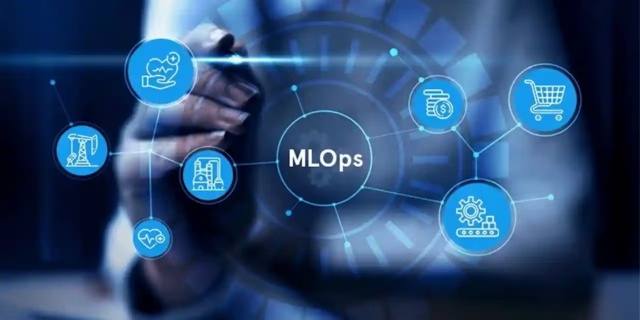
Building a Scalable MLOps Pipeline on Kubernetes
Introduction: Machine Learning Operations (MLOps) is transforming how organizations manage and deploy machine learning (ML) models into production. A robust and scalable MLOps pipeline is essential to handle the complexities of training, deploying, and maintaining machine learning models at scale. As the demand for real-time, data-driven applications grows, Kubernetes has emerged as the go-to platform...
MLOps vs. DevOps: Key Differences, Similarities, and Best Practices
Introduction: The rapid growth of machine learning (ML) has led to the emergence of a new set of practices tailored specifically for ML workflows—MLOps. As organizations seek to integrate machine learning models into their software systems, the need for specialized tools and processes has become clear. However, this raises the question: how does MLOps differ...
Kubernetes & Rancher: Open-Source Solutions for Scalable Orchestration
Introduction: The world of cloud-native applications is growing, and with this growth comes the challenge of effectively managing large-scale containerized applications. Kubernetes and Rancher are two powerful, open-source tools that have revolutionized container orchestration. Together, they offer seamless management of containerized workloads, scalability, and resilience. In this blog, we will explore how Kubernetes and Rancher...
Unlocking Seamless Security: Elevate Your VPN with AWS Client VPN
In today’s tech landscape, ensuring high availability and resilience is non-negotiable. Yet, one crucial area often overlooked is the VPN client endpoint’s impact, especially on remote teams. Imagine the smooth sailing of your hybrid on-premises/AWS cloud environment, with the majority of services thriving on AWS. Now, picture the advantages of shifting your company’s VPN endpoint...
Smooth Sailing : Running Druid on Kubernetes
Apache Druid is an open-source database system designed to facilitate rapid real-time analytics on extensive datasets. It excels in scenarios requiring quick “OLAP” (Online Analytical Processing) queries and is especially suited for use cases where real-time data ingestion, speedy query performance, and uninterrupted uptime are paramount. One of Druid’s primary applications is serving as the...
Stepping into DevSecOps: Five Principles for a Successful DevOps Transition
The DevOps field is flourishing for engineers, yet it confronts a pressing issue: security. Traditionally an afterthought, integrating security into the DevOps pipeline poses significant risks. As the “shift-left” security movement gains momentum, relying solely on DevOps expertise proves inadequate. Enter DevSecOps, the hailed successor of DevOps. This philosophy mandates security vigilance throughout software development...
Unleash the Power of AWS IoT Rules
In the era of the Internet of Things (IoT), billions of devices are interconnected, generating massive amounts of data. Extracting meaningful insights from this data requires robust mechanisms for processing, analyzing, and acting upon it. AWS IoT Rules, a powerful feature within Amazon Web Services’ IoT ecosystem, empowers businesses to automate actions based on data...
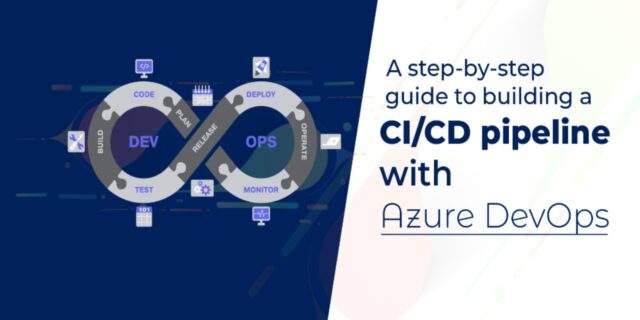
Effortless Software Delivery: A Deep Dive into Azure DevOps CI/CD
What is Azure DevOps?   Azure DevOps, Microsoft’s cloud-powered collaboration hub, unifies the entire software development lifecycle. Seamlessly integrating planning, coding, testing, and deployment, it empowers teams to innovate faster and deliver exceptional software with precision.   Let’s get started with Azure DevOps Pipelines …   Step 1: Signup for free Azure DevOps account Ready...
Exploring MLOps: Simplifying Machine Learning Operations
“Businesses are modernizing operations to boost productivity and enhance customer experiences. This digital shift accelerates interactions, transactions, and decisions, producing abundant data insights. Machine learning becomes a crucial asset in this context. Machine learning models excel in spotting complex patterns in vast data, offering valuable insights and informed decisions on a large scale. These models...
Introduction:

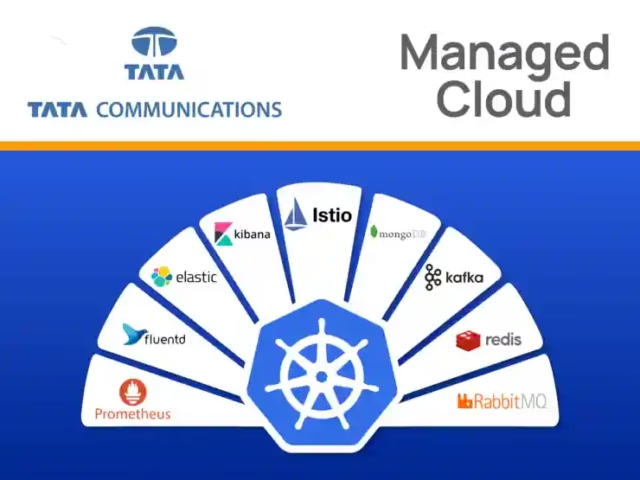
In the rapidly evolving landscape of data management, the need for a robust and scalable solution to store and manage vast amounts of data is paramount. In this case study, we delve into a client’s journey to establish a comprehensive database ecosystem within a Kubernetes environment hosted on a private cloud. The objective was to seamlessly integrate various databases such as MongoDB, Solr, RabbitMQ, ELK, Memcached, Redis, and Kafka while ensuring high availability, fault tolerance, and efficient monitoring.

Requirements:

Our client required an innovative approach to store and manage diverse data types efficiently. The need for a private cloud infrastructure aligned with their security and compliance standards. The key requirements included:

  • Kubernetes-based environment for dynamic scaling and resource allocation.
  • Installation and configuration of various databases to manage structured and unstructured data.
  • High availability to ensure uninterrupted access to critical data.
  • Fault tolerance to mitigate any potential system failures.
  • Backup and restore mechanisms to safeguard against data loss.
  • Centralized monitoring and alerting system for proactive issue identification.
  • Graphical visualization of database performance for insights and decision-making.
Challenges:

Integrating multiple databases within a Kubernetes cluster brought forth a range of challenges:

  • Diverse Database Technologies: Each database technology has its own deployment and management intricacies.
  • High Availability: Ensuring that data is accessible even in the event of node or pod failures.
  • Backup and Restore Strategies: Implementing effective strategies to back up and restore data seamlessly.
  • Monitoring Complexity: Monitoring various databases for performance and availability required careful planning.
  • Alerting System: Designing an alerting system to notify administrators of potential issues in real time.
  • Resource Allocation: Optimizing resource allocation for different databases to prevent resource contention.
  • Interoperability: Ensuring that different databases communicate efficiently within the Kubernetes cluster.
Solution:

To address the client’s requirements and overcome the challenges, a comprehensive solution was devised:

  • Database Deployment: Each database technology was containerized and deployed as Kubernetes pods to leverage dynamic scaling and resource allocation.
  • High Availability: Kubernetes StatefulSets were employed to ensure automatic failover and replication of pods.
  • Backup and Restore: Custom scripts were developed to automate backup and restore processes using persistent volumes and also we are configure cluster level backup and restore using velero and com-vault. 
  • Monitoring and Alerting: Prometheus was integrated to collect metrics, and Grafana was used to visualize and alert on database performance.
  • Resource Management: Resource quotas and limits were set for each database pod to prevent resource starvation.
  • Inter-Database Communication: Kubernetes Services facilitated seamless communication between different databases.
  • Testing Scenarios: Various fault tolerance and high availability scenarios were tested, including simulated node failures and network disruptions.
The Approach:

Achieving the successful implementation of the resilient database ecosystem required a meticulous approach that involved several key steps:

  • Database Evaluation and Selection: A thorough assessment of the client’s data requirements led to the careful selection of appropriate database technologies, each tailored to handle specific data types and workloads.
  • Containerization and Orchestration: Each chosen database was containerized using Docker and orchestrated within Kubernetes pods. This approach allowed for seamless deployment, scaling, and management of databases, fostering consistency across the ecosystem.
  • StatefulSet and Persistent Volumes: To ensure high availability and data persistence, Kubernetes StatefulSets were utilized. Coupled with persistent volumes, this approach facilitated automatic failover and efficient data storage.
  • Automated Backup and Restore: Custom scripts were developed to automate the backup and restore processes. These scripts utilized Kubernetes Persistent Volume Claims to ensure data integrity and availability during potential recovery scenarios.
  • Monitoring and Alerting Integration: Prometheus, a leading open-source monitoring and alerting toolkit, was integrated to collect comprehensive metrics from each database pod. Grafana provided real-time visualization and alerting capabilities, enabling rapid response to performance anomalies.
Benefits Achieved:

The implemented solution delivered a range of substantial benefits to the client:

  • Enhanced Scalability: The use of Kubernetes allowed the client’s database ecosystem to seamlessly scale based on evolving data needs, ensuring optimal resource allocation.
  • Uninterrupted Access: High availability and fault tolerance mechanisms enabled uninterrupted access to critical data, even during system disruptions.
  • Data Integrity: Automated backup and restore processes safeguarded against potential data loss, promoting data integrity and business continuity.
  • Proactive Issue Identification: The integration of Prometheus and Grafana provided a proactive monitoring system that enabled administrators to detect and address performance issues before they could impact operations.
  • Centralized Management: A unified management platform enabled administrators to efficiently oversee various databases, streamlining operations and reducing overhead.
  • Informed Decision-Making: Visualizations offered by Grafana empowered stakeholders with insights into database performance, supporting informed decision-making.
Conclusion:

By leveraging Kubernetes and carefully orchestrating diverse databases within a private cloud environment, our client achieved a resilient and scalable database ecosystem. The successful implementation ensured high availability, fault tolerance, backup and restore mechanisms, and efficient monitoring. The integration of Prometheus and Grafana enhanced the visibility into database performance, enabling prompt issue resolution and informed decision-making. This case study underscores the power of Kubernetes in orchestrating complex database environments, providing a blueprint for organizations aiming to build a robust data management infrastructure.
Introduction:

Our client, cosmedix, a prominent cosmetics retailer, faced numerous challenges with their Magento e-commerce platform. Initially hosted on a single virtual machine (VM), their setup struggled with scalability, incurred high operational costs, and lacked efficient resource management. Under heavy traffic, the VM could not handle load efficiently, leading to performance issues, increased downtime, and rising costs. cosmedix partnered with Texple Technologies to optimize, secure, and scale their Magento platform. We designed and implemented a comprehensive Azure Kubernetes Service (AKS)-based solution that enhanced performance, improved security, and significantly reduced costs. Our approach included Azure DevOps for CI/CD, DevSecOps for security, and advanced monitoring tools like ELK and Grafana, transforming Cosmedix’s infrastructure into a high-performing, cost-effective environment.


Requirements:

cosmedix’s objectives for this project included:

  1. Migrating Magento to a Scalable Cloud Infrastructure: Moving from a single VM to a resilient, scalable AKS environment to handle dynamic traffic.
  2. CI/CD Pipeline with Secure Branching: Implementing automated CI/CD pipelines with Azure DevOps and GitLab, following secure branching practices for streamlined deployments and version control.
  3. Enhanced Security with DevSecOps: Securing the platform with best-practice DevSecOps, including code quality checks, SSL management, and continuous vulnerability assessments.
  4. Cost Optimization: Reducing cloud expenses through effective resource management and cost-saving strategies.
  5. Comprehensive Monitoring and Alerting: Deploying real-time monitoring, alerting, and log aggregation for proactive issue management.
Challenges:

The existing setup presented multiple obstacles:

  1. Scalability Limitations: A single VM could not handle peak loads efficiently, causing performance bottlenecks and downtime during high traffic.
  2. Security and Compliance: The platform required strict security standards, SSL management, and continuous vulnerability monitoring.
  3. Operational Complexity: Frequent updates and server maintenance made the VM infrastructure hard to manage.
  4. Cost Control: Rising operational costs on the VM setup emphasized the need for an optimized cloud environment.
  5. Monitoring Gaps: Lack of effective monitoring and alerting limited cosmedix’s ability to quickly respond to issues, impacting uptime and user experience.
Solution:

To address these challenges, Texple Technologies implemented a fully containerized AKS solution, with best practices in DevOps, DevSecOps, and monitoring. Our approach included:

  1. Environment Setup on AKS:

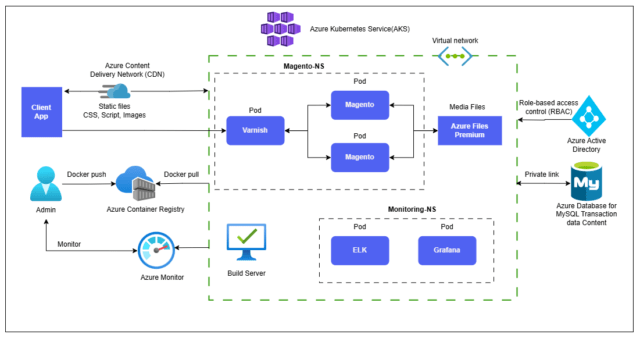
    • Migrated the Magento application to AKS, deploying it as a set of pods. This allowed us to utilize autoscaling to handle variable traffic loads, which reduced costs and optimized resource usage.
    • Varnish was deployed as a stateful set with replica sets for efficient load balancing and caching, improving application speed and distributing traffic to ensure consistent performance.
    • Azure Managed Database for MySQL was configured to handle transactional data, with high availability, backups, and automatic scaling.

  2. GitLab Branching Strategy and CI/CD with Azure DevOps:

   We structured the GitLab repository with environment-specific and feature-specific branches to streamline development:

    • Environment Branches: dev, qa, uat, prod
    • Feature Branchesfeature/<feature_name_or_ticket_id>
    • Bug Fix Branchesbug/<ticket_id>
    • Code Refactor Branches: refactor/<feature_name_or_ticket_id>
    • Hotfix Brancheshotfix/<ticket_id>
    • Release Tags followed semantic versioning (e.g., v1.1.3), ensuring clear version control and deployment flow.
    • Azure DevOps CI/CD pipelines were configured to automate builds, testing, and deployments, allowing seamless promotion across dev, qa, uat, and production environments.

  3. DevSecOps Practices:

    • We integrated DevSecOps practices to enhance security across the platform:
    • Code Quality ScanningAutomated scans and code reviews to ensure high standards.
    • Vulnerability Assessments and Penetration Testing (VAPT): Regular assessments to identify and mitigate vulnerabilities.
    • SSL Certificate Management: Managed SSL for all environments to ensure secure transactions and protect user data.
    • Azure Active Directory (AAD): Integrated AAD login for Magento using a plugin, enabling users to authenticate with enterprise-grade security.

  4. Advanced Monitoring with ELK Stack and Grafana:

    •  ELK Stack (Elasticsearch, Logstash, Kibana) was implemented to monitor logs from all Kubernetes pods, enabling centralized log aggregation and in-depth analytics.
    • Prometheus and Grafana were deployed for performance monitoring, with custom dashboards showing real-time resource usage and application health.
    • Azure Monitor provided real-time alerts for critical issues, enhancing our ability to respond quickly and maintain uptime.

  5. Cost Optimization and Resource Management:

    • Azure Reserved Instances and Azure Cost Management tools were used to control expenses.
    • Continuous monitoring and rightsizing of resources allowed us to minimize idle capacity, resulting in a 30% reduction in overall costs.

  6. Azure Content Delivery Network (CDN):

    • We utilized Azure CDN to deliver static content (CSS, scripts, images) directly to the client’s users, reducing latency and offloading traffic from the main application.


Architecture:


Approach:

Our solution was implemented through a phased, structured approach:

  1. Assessment and Planning: Analyzed the existing infrastructure, traffic patterns, and resource usage to create a tailored migration plan.
  2. Containerization and Migration: Containerized Magento and deployed it on AKS, using Azure MySQL for reliable data storage.
  3. CI/CD and GitLab Integration: Configured branching strategies and pipelines in GitLab and Azure DevOps to automate deployments and align with the client’s operational flow.
  4. Security Hardening with DevSecOps: Integrated SSL management, continuous VAPT, and role-based access with AAD.
  5. Monitoring Setup: Implemented ELK and Grafana, providing real-time monitoring, proactive alerts, and performance visualization.
Services Implemented:
  1. AKS Migration and Scaling: Enabled auto-scaling with AKS for efficient resource allocation.
  2. GitLab and Azure DevOps CI/CD: Structured GitLab repository and pipelines for continuous integration and deployment.
  3. DevSecOps Practices: Enhanced code quality, vulnerability assessments, SSL management, and security compliance.
  4. Monitoring with ELK and Grafana: Real-time monitoring, alerts, and log analysis using Azure Monitor, ELK, and Grafana.
  5. Cost Optimization: Used Azure Reserved Instances and rightsizing for cost-effective resource management.
  6. CloudOps and Maintenance: Load balancing, proactive monitoring, and optimized resource allocation ensured consistent performance.


Benefits Achieved:

After implementing this solution, Cosmedix’s saw significant improvements:

  1. Enhanced Scalability: AKS auto-scaling allowed the platform to meet variable traffic demands without compromising performance.
  2. Improved Security: DevSecOps practices and AAD integration provided a robust security framework.
  3. Efficient CI/CD and Deployment: Azure DevOps pipelines enabled fast, reliable deployments across environments.
  4. Reduced Costs: Optimized configurations and Azure Reserved Instances led to a 30% cost reduction.
  5. Proactive Monitoring: Real-time alerts and detailed dashboards minimized downtime and allowed quick issue resolution.
  6. Superior User Experience: Faster load times, secure transactions, and consistent uptime resulted in a smoother and more reliable user experience.


Conclusion:

Texple Technologies’ work with Cosmedix demonstrates the effectiveness of migrating Magento to a cloud-native, containerized infrastructure on AKS. Our solution not only improved scalability, security, and monitoring but also significantly reduced operational costs. By leveraging advanced DevOps, DevSecOps, and monitoring tools, we delivered a platform that is resilient, cost-efficient, and ready for future growth. This transformation has positioned Cosmedix to succeed in the highly competitive cosmetics industry, ensuring their e-commerce platform remains responsive, secure, and efficient.


Introduction:

Our client, a well-known E-Commerce retailer, faced challenges with their on-premises Drupal environment, including limited scalability, high operational costs, and complex resource management. Hosted on aging infrastructure, their Drupal-based platform encountered frequent performance issues, struggled with peak traffic, and incurred excessive expenses. They engaged Texple Technologies to modernize, secure, and optimize their environment. Leveraging Azure Kubernetes Service (AKS), GitLab for CI/CD, and advanced monitoring tools, we provided a cost-efficient, scalable, and secure solution that empowered the client to meet their evolving needs with agility.


Requirements:

The client’s objectives included:

  • Migrating their on-premises Drupal environment to a scalable, resilient cloud infrastructure on Azure.
  • Establishing a CI/CD pipeline using GitLab, with branching strategies for streamlined deployments and efficient version control.
  • Enhancing security through DevSecOps practices, code quality checks with SonarQube, and SSL management.
  • Implementing cost-optimization techniques, including automated start/stop logic for resources.
  • Proactively monitoring infrastructure health and performance using Prometheus and Grafana.
  • Ensuring robust security with firewalls, encryption, and automated certificate renewals.
  • Maintaining high availability and disaster recovery (HA/DR) capabilities.
  • Conducting regular smoke and mock drill tests every quarter to validate system resilience and readiness.


Challenges:

The existing infrastructure presented several challenges:

  1. Scalability Constraints: On-premises servers struggled with peak loads, leading to slow response times and occasional downtime during high-traffic periods.
  2. Security Gaps: The client required heightened security standards, including SSL certificate renewals, periodic vulnerability testing, and DevSecOps integration.
  3. Cost Control: Rising on-premises infrastructure and maintenance costs necessitated a move to a more efficient, cloud-based solution.
  4. Complex Infrastructure Management: Frequent updates, server maintenance, and scaling requirements made operations cumbersome and resource-intensive.
  5. Monitoring Limitations: Lack of proactive monitoring and real-time alerts created delays in addressing performance and security issues.


Solution:

Our team at Texple Technologies developed and implemented a comprehensive cloud solution on Azure, leveraging AKS for scalability, GitLab for CI/CD, SonarQube for code quality, and other essential Azure tools. Key components of our solution included:

1. Environment Migration and Setup on AKS:
  • We containerized the Drupal application and migrated it to Azure Kubernetes Service (AKS), enabling seamless autoscaling based on demand, reducing costs, and eliminating performance bottlenecks.
  • Configured AKS clusters with separate node pools to handle different workloads, enabling efficient resource allocation.
2. CI/CD Pipeline with GitLab:
  • Implemented structured GitLab branching strategies to support isolated environments for development, QA, staging, and production:
    • Environment Branches: dev, qa, uat, prod
    • Feature Branches: feature/<feature_name or ticket_id>
    • Bug Fix Branches: bug/<ticket_id>
    • Hotfix Branches: hotfix/<ticket_id>
  • Configured automated CI/CD pipelines to build, test, and deploy code changes seamlessly across environments, reducing manual intervention and deployment time.
3. DevSecOps and Security Hardening:
  • Integrated SonarQube for code quality and vulnerability assessments, ensuring each code deployment met security and quality standards.
  • Managed SSL certificate renewals and enabled firewall rules for restricted access, securing the application and its data.
  • Conducted regular vulnerability assessments and penetration testing (VAPT) to detect and remediate potential security threats.
4. Monitoring and Proactive Alerts with Grafana and Prometheus:
  • Configured Prometheus and Grafana for comprehensive monitoring of application performance, resource utilization, and system health.
  • Created custom dashboards per client requirements and set up real-time alerts via WhatsApp, SMS, and email using Twilio, notifying both the client and our team to maintain system stability and reduce downtime.
5. Cost Optimization Strategies:
  • Implemented resource start/stop logic to automatically suspend idle instances during non-peak hours, resulting in significant cost savings.
  • Used Azure Reserved Instances and optimized resource allocation through Azure Cost Management, reducing expenses by up to 30%.
  • Conducted regular infrastructure assessments and rightsizing to ensure efficient resource utilization and prevent unnecessary costs.
6. High Availability and Disaster Recovery (HA/DR):
  • Deployed a robust HA/DR strategy, maintaining secondary failover instances and regular automated backup schedules.
  • Conducted quarterly smoke tests and mock disaster recovery drills, ensuring the system remains resilient under potential failure scenarios.
7. OS-Level Security Patching and Vulnerability Management:

To maintain security compliance and stability, we implemented automated OS patching and updates across all containerized and non-containerized resources in the Azure environment. This included:

  • Automated Patch Management: Configured automated patching for the OS of both container nodes in AKS and other VM-based resources using Azure Automation Update Management, ensuring that all critical updates and security patches were applied promptly without manual intervention.
  • Version Control and Upgrade Strategy: Regularly updated underlying OS versions and dependencies to mitigate security vulnerabilities and ensure compatibility with application requirements.
  • Vulnerability Testing and Assessment: Conducted periodic vulnerability assessments, including OS-level security scanning, to identify and resolve potential issues proactively. Utilized Azure Security Center and integrated vulnerability assessment tools for comprehensive scanning and remediation.
  • Compliance and Audit Readiness: Maintained logs of all updates, patching activities, and security fixes for compliance reporting and audit requirements, ensuring that the environment met industry security standards and best practices.


Approach:

Our phased approach ensured a smooth and effective migration and implementation:

  1. Assessment and Planning: Evaluated the existing on-premises infrastructure, analyzed resource usage, and identified areas for improvement and security gaps.
  2. Containerization and AKS Deployment: Dockerized the Drupal application and configured AKS clusters for demand-based scaling, load balancing, and isolated workload management.
  3. CI/CD and GitLab Setup: Established GitLab CI/CD pipelines and branching strategies, aligning the repository structure with the client’s deployment requirements.
  4. Security Implementation: Applied DevSecOps standards, SSL management, and regular security assessments to protect the application from vulnerabilities.
  5. OS-Level Security and Maintenance : Stage, focusing on proactive system health and security
    • Automated Patching Setup: Implemented Azure Automation and configured update schedules for OS-level patching, ensuring minimal disruption during non-peak hours.
    • OS Security Vulnerability Management: Integrated vulnerability scanning and reporting mechanisms, establishing a clear workflow for patching, version updates, and incident management to maintain system integrity.
  6. Monitoring Integration: Set up Prometheus and Grafana for real-time monitoring and custom alerting, enabling proactive issue resolution and enhanced operational insights.


Services Implemented:
  • AKS for Containerized Scaling: Autoscaling and optimized resource allocation on AKS to handle variable traffic loads.
  • GitLab CI/CD and Branching: Streamlined deployments with a structured GitLab repository and environment-specific branching strategies.
  • SonarQube and DevSecOps: Ensured code quality and security with automated code reviews, vulnerability scans, and SSL management.
  • Prometheus and Grafana Monitoring: Real-time alerts and custom Grafana dashboards for proactive issue resolution.
  • Azure Automation for OS Patching and Maintenance: Enabled scheduled and automated OS patching across all critical infrastructure to ensure system stability and security.
  • Vulnerability Management Tools: Utilized Azure Security Center and additional vulnerability assessment tools to identify and remediate OS-level threats, minimizing potential attack vectors.
  • Cost Optimization Techniques: Implemented start/stop logic and Azure Reserved Instances for efficient cost management.
  • High Availability and Disaster Recovery: Maintained system resilience with failover support and quarterly recovery testing.


Benefits Achieved:

Our solution brought measurable improvements in both performance and cost-efficiency:

  • Enhanced Scalability: AKS autoscaling enabled the client to meet variable demands smoothly, without performance issues.
  • Stronger Security Standards: DevSecOps practices ensured continuous security monitoring, compliance, and SSL certificate management.
  • Streamlined Deployment: GitLab CI/CD pipelines and branching strategies reduced deployment time, enhancing productivity and reliability.
  • Significant Cost Reduction: Optimized configurations and cost-saving techniques resulted in a 30% reduction in operational costs.
  • Enhanced System Security: With automated OS patching and proactive vulnerability management, the client’s infrastructure achieved a heightened level of security, reducing the risk of exploits.
  • Improved Compliance and Audit Readiness: Automated patch management and comprehensive security logging ensured compliance with industry standards and readiness for periodic security audits.
  • Minimized Downtime: By automating patching during low-traffic periods, we minimized operational interruptions, providing a stable and secure environment for the client.
  • Improved Monitoring and Incident Response: Real-time alerts through Twilio integrations minimized downtime and ensured rapid issue resolution.
  • Higher Client Satisfaction: With enhanced uptime, quick response times, and consistent security, the client enjoyed a smooth, reliable experience.


Conclusion:

This project with the E-Commerce retailer highlights the value of migrating Drupal to Azure Kubernetes Service, combined with a robust GitLab CI/CD framework and security-first approach. Our optimized solution empowered the client to scale dynamically, reduce operational costs, and maintain a high level of security and resilience. By continuously monitoring, fine-tuning, and testing the environment, Texple Technologies ensured that the client’s platform was well-equipped to support future growth, setting a strong foundation for ongoing success in the competitive E-Commerce industry.