




HomePortfolio

Portfolio Archive | Texple

Globally incubate standards compliant channels before scalable benefits. Quickly disseminate superior deliverables whereas web-enabled applications. Quickly drive clicks-and-mortar catalysts for change before vertical architectures.

Blogs

Globally incubate standards compliant channels before scalable benefits. Quickly disseminate superior deliverables whereas web-enabled applications. Quickly drive clicks-and-mortar catalysts for change before vertical architectures.
bt_bb_section_bottom_section_coverage_image
The Future of DevSecOps: How AI is Enhancing Security in Software Development
Introduction In today’s fast-paced software development landscape, security can no longer be an afterthought. DevSecOps (Development, Security, and Operations) integrates security into every phase of the software development lifecycle (SDLC), ensuring that applications are secure by design. However, traditional security practices often struggle to keep up with rapid development cycles, leading to vulnerabilities and compliance...
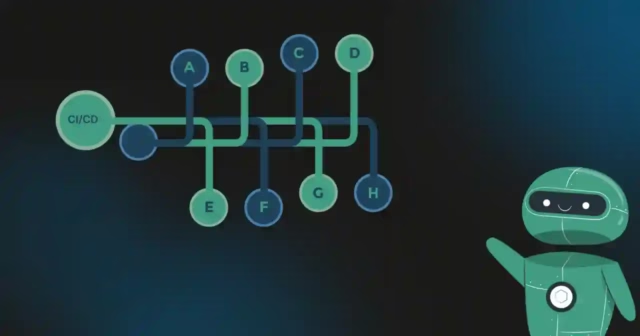
AI in DevOps: How AI is Revolutionizing CI/CD Pipelines
Introduction In modern software development, Continuous Integration (CI) and Continuous Deployment (CD) have become crucial for automating builds, testing, and deployments. However, traditional CI/CD pipelines often suffer from inefficiencies like slow builds, flaky tests, security vulnerabilities, and manual interventions. With the integration of Artificial Intelligence (AI) and Machine Learning (ML), DevOps teams can optimize their...
Building Smarter Web Applications with AI and Machine Learning
Introduction Web applications have evolved significantly with the integration of Artificial Intelligence (AI) and Machine Learning (ML). AI-powered web apps provide personalized experiences, automation, predictive analytics, and intelligent decision-making. From chatbots and recommendation systems to fraud detection and image recognition, AI is reshaping how web applications function. This blog will explore how AI and ML...
AI-Powered Web Development: How AI is Automating Frontend and Backend Development
Introduction Web development is evolving rapidly, and Artificial Intelligence (AI) is at the forefront of this transformation. AI-powered tools and automation are revolutionizing both frontend and backend development, making web applications more efficient, scalable, and personalized. From automated code generation and AI-powered UI/UX design to intelligent backend management and security monitoring, AI is reducing the...
Top Mobile App Development Trends in 2025: AI, 5G, and Beyond
Introduction The mobile app development landscape is evolving rapidly, with AI, 5G, blockchain, AR/VR, and edge computing shaping the future. In 2025, mobile applications will be smarter, faster, and more immersive, providing users with hyper-personalized experiences and seamless connectivity. From AI-driven chatbots and real-time video streaming with 5G to blockchain-based security and AR-powered shopping experiences,...
AI in Mobile Apps: How Machine Learning is Transforming User Experience
Introduction Artificial Intelligence (AI) and Machine Learning (ML) are revolutionizing the mobile app industry, making applications smarter, faster, and more personalized. From voice assistants and predictive text to real-time language translation and AI-powered recommendations, machine learning is enhancing the way users interact with mobile apps. With GPT-4 and beyond, AI-driven mobile applications are providing hyper-personalized...
Best Practices for Building AI Chatbots That Feel More Human
Introduction AI chatbots have transformed customer interactions, business automation, and digital experiences. However, many chatbots still feel robotic, impersonal, or frustrating due to a lack of emotional intelligence, contextual understanding, and natural conversation flow. The key to success is making chatbots feel more human-like by enhancing their ability to understand emotions, adapt responses, and engage...
How Chatbots are Evolving with GPT-4 and Beyond
How Chatbots are Evolving with GPT-4 and Beyond Introduction Chatbots have transformed the way businesses and individuals interact with technology. From simple rule-based bots to advanced AI-driven conversational agents, the evolution of chatbots has been remarkable. With the advent of GPT-4, chatbots have reached unprecedented levels of intelligence, fluency, and contextual understanding. But what’s next?...
Configuring Zabbix for Endpoint Monitoring on an Endpoint
In this blog post, I’ll walk you through the steps to set up Zabbix for endpoint monitoring. Zabbix is an open-source monitoring solution that helps in tracking network and application performance, and it’s ideal for monitoring endpoint servers. We’ll be hosting it inside an AWS EC2 instance, configuring the installation, and then setting up monitoring...
AWS Landing Zone & AWS Control Tower: A Complete Guide
Introduction As organizations migrate to the cloud, managing multiple AWS accounts and ensuring consistent governance and security can become a complex task. AWS provides tools like AWS Landing Zone and AWS Control Tower to simplify the process of setting up a secure and scalable multi-account AWS environment. This blog explores both solutions, comparing their features,...
mastering-service-mesh-in-kubernetes
Introduction Kubernetes has revolutionized the way we deploy, manage, and scale applications. It provides the infrastructure needed for managing microservices at scale, ensuring efficient container orchestration. However, with Kubernetes’ flexibility and the increasing complexity of microservices, service-to-service communication becomes increasingly challenging. A key solution to this is the use of a service mesh. But, when...
Building a Scalable MLOps Pipeline on Kubernetes
Introduction: Machine Learning Operations (MLOps) is transforming how organizations manage and deploy machine learning (ML) models into production. A robust and scalable MLOps pipeline is essential to handle the complexities of training, deploying, and maintaining machine learning models at scale. As the demand for real-time, data-driven applications grows, Kubernetes has emerged as the go-to platform...
MLOps vs. DevOps: Key Differences, Similarities, and Best Practices
Introduction: The rapid growth of machine learning (ML) has led to the emergence of a new set of practices tailored specifically for ML workflowsβ€”MLOps. As organizations seek to integrate machine learning models into their software systems, the need for specialized tools and processes has become clear. However, this raises the question: how does MLOps differ...
Kubernetes & Rancher: Open-Source Solutions for Scalable Orchestration
Introduction: The world of cloud-native applications is growing, and with this growth comes the challenge of effectively managing large-scale containerized applications. Kubernetes and Rancher are two powerful, open-source tools that have revolutionized container orchestration. Together, they offer seamless management of containerized workloads, scalability, and resilience. In this blog, we will explore how Kubernetes and Rancher...
Unlocking Seamless Security: Elevate Your VPN with AWS Client VPN
In today’s tech landscape, ensuring high availability and resilience is non-negotiable. Yet, one crucial area often overlooked is the VPN client endpoint’s impact, especially on remote teams. Imagine the smooth sailing of your hybrid on-premises/AWS cloud environment, with the majority of services thriving on AWS. Now, picture the advantages of shifting your company’s VPN endpoint...
Smooth Sailing : Running Druid on Kubernetes
Apache Druid is an open-source database system designed to facilitate rapid real-time analytics on extensive datasets. It excels in scenarios requiring quick “OLAP” (Online Analytical Processing) queries and is especially suited for use cases where real-time data ingestion, speedy query performance, and uninterrupted uptime are paramount. One of Druid’s primary applications is serving as the...
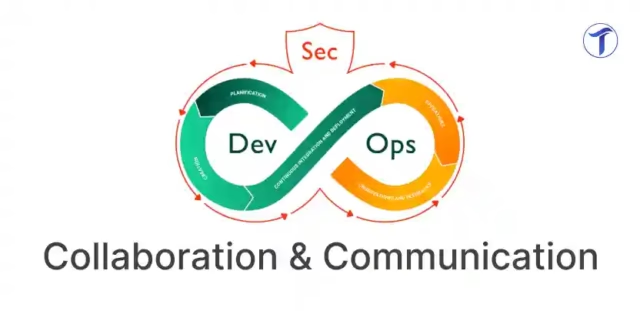
Stepping into DevSecOps: Five Principles for a Successful DevOps Transition
The DevOps field is flourishing for engineers, yet it confronts a pressing issue: security. Traditionally an afterthought, integrating security into the DevOps pipeline poses significant risks. As the “shift-left” security movement gains momentum, relying solely on DevOps expertise proves inadequate. Enter DevSecOps, the hailed successor of DevOps. This philosophy mandates security vigilance throughout software development...
Unleash the Power of AWS IoT Rules
In the era of the Internet of Things (IoT), billions of devices are interconnected, generating massive amounts of data. Extracting meaningful insights from this data requires robust mechanisms for processing, analyzing, and acting upon it. AWS IoT Rules, a powerful feature within Amazon Web Services’ IoT ecosystem, empowers businesses to automate actions based on data...
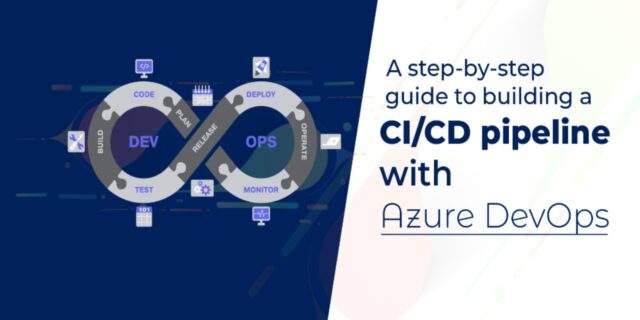
Effortless Software Delivery: A Deep Dive into Azure DevOps CI/CD
What is Azure DevOps?   Azure DevOps, Microsoft’s cloud-powered collaboration hub, unifies the entire software development lifecycle. Seamlessly integrating planning, coding, testing, and deployment, it empowers teams to innovate faster and deliver exceptional software with precision.   Let’s get started with Azure DevOps Pipelines …   Step 1: Signup for free Azure DevOps account Ready...
Exploring MLOps: Simplifying Machine Learning Operations
“Businesses are modernizing operations to boost productivity and enhance customer experiences. This digital shift accelerates interactions, transactions, and decisions, producing abundant data insights. Machine learning becomes a crucial asset in this context. Machine learning models excel in spotting complex patterns in vast data, offering valuable insights and informed decisions on a large scale. These models...
Introduction:

In today’s fast-paced e-commerce environment, personalization is no longer optionalβ€”it’s a necessity for driving customer engagement and revenue. One of the top 10 global fashion e-commerce companies partnered with Texple to transform its legacy recommendation engine that failed to adapt to user intent in real time.

Texple implemented an AI-driven solution leveraging Amazon Titan Multimodal Embeddings via AWS Bedrock, delivering personalized, context-aware recommendations that improved the customer experience and core business metrics.

Requirements:
  • Create a responsive recommendation engine that understands both textual and visual product attributes

  • Adapt suggestions based on real-time user behavior and intent shifts

  • Enable users to discover products via both text and image inputs

  • Improve user engagement and reduce cart abandonment

  • Integrate seamlessly with the client’s existing AWS infrastructure

Challenges:


The client’s existing product recommendation system relied on traditional filtering techniques and simple logic, resulting in a static, one-size-fits-all experience that was no longer sufficient for modern user expectations.

Key limitations included:

  • Lack of personalization: Recommendations were based on general categories with little variation across users

  • Inability to understand visual or textual context: No comprehension of detailed product attributes

  • No dynamic updates: In-session preference changes weren’t reflected in real time

  • Weak discovery experience: Complex or multi-attribute queries returned poor results

These limitations led to lower engagement, higher bounce rates, and reduced customer retention.

Solution:

Texple built a next-generation product recommendation engine using Amazon Titan Multimodal Embeddings hosted on AWS Bedrock. The system integrated real-time behavioral data, natural language understanding, and image recognition to power intelligent product discovery.

Architecture

Approach

Step 1: Multimodal Product Understanding
Texple used Amazon Titan to generate embeddings for each product by processing:

  • Product descriptions

  • Product images

  • Structured metadata

This enabled the system to suggest products based on deeper features such as color, texture, and design, rather than only by category.

Step 2: Real-Time Behavioral Personalization
The AI engine monitored user activityβ€”clicks, searches, time spent on product pages, and cart behaviorβ€”and adjusted recommendations in real time. For example, if a user shifted from browsing leather boots to hiking shoes, the recommendations adapted accordingly.

Step 3: Enhanced Search and Visual Discovery
The platform supported both keyword and image-based searches. Users could upload photos or enter specific queries like β€œred memory foam running shoes,” and receive accurate matches based on both visual and textual cues.

Step 4: Personalized Homepages and Targeted Promotions
Texple implemented AI-driven homepage modules that changed dynamically based on:

  • Browsing and shopping history

  • Abandoned cart contents

  • Preferred product categories

Services Implemented
  • Amazon Bedrock for serverless deployment of foundation models

  • Amazon Titan Multimodal Embeddings for image and text processing

  • Amazon S3 for storing product metadata and session logs

  • Amazon CloudWatch for performance monitoring

  • AWS Lambda and API Gateway for real-time API-driven personalization

  • Optional integration with Amazon Personalize for collaborative filtering

Benefits Achieved
  • 40% increase in conversion rates due to smarter recommendations

  • 60% faster product discovery via improved search experiences

  • 35% higher customer retention through engaging, personalized interfaces

  • 50% more interaction with visual search tools

  • 24% growth in average order value (AOV)

  • Noticeable decrease in cart abandonment driven by timely deal prompts

Conclusion

Texple’s AI-powered personalization solution, backed by Amazon Titan and AWS Bedrock, enabled the client to significantly modernize its e-commerce experience. The unified recommendation engine, combining multimodal understanding with behavioral insights, delivered meaningful results: higher conversions, better retention, and a more satisfying customer journey.

If your organization is ready to scale intelligent personalization with enterprise-grade AI, Texple is the partner to make it happen.
Introduction:

The healthcare industry continues to face mounting pressure due to rising administrative burdens, physician burnout, and limited availability of real-time patient support. A prominent multi-specialty hospital systemβ€”ranked among the top 10 nationallyβ€”partnered with Texple to modernize its medical documentation process and streamline patient engagement.

To address these challenges, Texple implemented Anthropic Claude 2.1, an advanced language model hosted on AWS Bedrock, enabling real-time transcription, automated documentation, intelligent clinical support, and 24/7 patient interaction. The result was a significant reduction in physician workload, improved care delivery, and increased operational efficiency.

Requirements:
  • Eliminate the need for manual medical documentation

  • Support physicians with instant access to clinical guidelines and summaries

  • Enable 24/7 patient engagement through conversational AI

  • Reduce administrative overhead across departments

  • Ensure HIPAA-compliant integration with EHR systems

Challenges:

The client faced several operational and clinical challenges impacting both patient outcomes and internal productivity.

  • Manual documentation overload: Physicians spent hours inputting data into EHRs, cutting into patient care time

  • Physician burnout and low morale: Staff were overburdened with administrative tasks

  • Inconsistent and unstructured records: Manual entries introduced risks of error and compliance issues

  • Delayed patient assistance: Queries went unanswered outside office hours

  • High administrative costs: Significant resources were allocated to staffing transcriptionists and call centers

Solution:

Texple designed and deployed a scalable, secure, and intelligent automation pipeline using Claude 2.1 integrated via AWS Bedrock. The solution was tailored to meet HIPAA standards and seamlessly integrated with the hospital’s existing EHR and engagement platforms.

Approach

Step 1: Automated Medical Documentation

Claude 2.1 was configured to transcribe doctor-patient interactions in real time and convert them into structured, EHR-compatible medical notes.

Example: Doctor input: β€œPatient is a 58-year-old female with type 2 diabetes, complaining of fatigue. Starting metformin and recommending blood sugar monitoring.”

Claude 2.1 Generated Output:

Patient Name: John Doe 
Age: 45 
Condition: Hypertension 
Symptoms: Chest pain 
Diagnosis: High cholesterol, potential cardiovascular risk 
Prescription: Atorvastatin 10mg daily 
Recommendations: Low-sodium diet, increased physical activity, follow-up in 4 weeks

This eliminated the need for post-visit documentation and ensured consistency and completeness across records.

Step 2: AI-Assisted Clinical Decision Support

Texple trained Claude 2.1 to analyze patient history and clinical data to suggest guideline-based treatments.

For instance, when asked for updated treatment protocols for a diabetic patient with kidney concerns, the AI referred to ADA 2023 guidelines, recommending SGLT2 inhibitors due to renal benefits.

Physicians could now receive rapid clinical insights, improving decision-making and consultation efficiency.

Step 3: Virtual Patient Interaction via AI Chatbots

Texple deployed Claude 2.1-powered virtual assistants across the hospital’s website and mobile app to support patients 24/7. These assistants handled:

  1. Appointment scheduling

  2. Medication reminders

  3. Symptom analysis and triage

  4. Basic health inquiries

This reduced the dependency on call center staff while ensuring patients received timely assistance.

Step 4: Intelligent Report Summarization

Long lab and diagnostic reports were condensed by Claude 2.1 into one-paragraph physician-ready summaries.

Example: Input: 12-page cardiac report
Output: β€œPatient shows elevated cholesterol and moderate arterial plaque buildup. Recommend statin therapy and dietary changes. Schedule follow-up imaging in 6 months.”

Physicians gained more time for patient interaction by avoiding report fatigue.

Business Impact & Measurable Benefits:

Following implementation, the healthcare provider reported substantial improvements:

  1. 60% reduction in documentation time

  2. 70% faster medical note turnaround

  3. Doctors saved over 10 hours per week

  4. 24/7 chatbot availability reduced patient wait times

  5. 50% decrease in administrative overhead related to documentation

  6. Improved compliance with HIPAA and audit-readiness

  7. Higher patient satisfaction scores due to timely support

Architecture:

Services Implemented
  • AWS Bedrock for model hosting without infrastructure overhead

  • Anthropic Claude 2.1 for transcription, summarization, and conversation

  • Amazon S3 for secure patient data storage

  • AWS Lambda for automating response logic

  • Amazon API Gateway for communication between EHR systems and AI modules

  • Amazon CloudWatch for monitoring performance and logging

Benefits Achieved
  1. 60% reduction in documentation time

  2. 70% faster generation of medical notes

  3. Over 10 hours saved per doctor, per week

  4. 24/7 patient assistance without expanding support staff

  5. 50% decrease in documentation-related administrative overhead

  6. Higher compliance with HIPAA and audit-readiness

  7. Significant improvement in patient satisfaction


Conclusion:

Texple’sΒ AI-driven healthcare automation using Claude 2.1 on AWS Bedrock enabled physicians to focus on patient care, not paperwork. Through real-time documentation, 24/7 patient support, and smart summarization, hospitals reduced operational costs and improved both staff productivity and patient outcomes.

This case study proves how AI in healthcare is not just innovativeβ€”it’s essential. For organizations looking to elevate their care delivery while improving efficiency, TexpleΒ provides the expertise to make it happen.


Introduction:

In today’s fast-paced digital landscape, traditional software development processes, heavily reliant on manual coding, debugging, and testing, face significant challenges in maintaining speed, quality, and security. Texple partnered with a leading FinTech company, recognized as one of the top financial technology providers globally, to transform its software development lifecycle. The goal was to leverage AI-powered automation to accelerate development, reduce errors, and enhance code quality and security compliance.

Requirements:

The client required a robust solution capable of:

  • Automating code generation for efficient software development.
  • Implementing real-time debugging and vulnerability detection.
  • Automating test case creation and execution.
  • Maintaining code consistency and scalability across large development teams.
  • Ensuring high security and regulatory compliance standards.
Challenges:

The client’s traditional software development approach faced multiple challenges:

  1. Lengthy Development Cycles: Extensive time was spent manually writing repetitive boilerplate code and APIs, significantly slowing down project timelines.
  2. Increased Human Errors: Manual coding introduced typos, syntax errors, and logic flaws, resulting in increased debugging efforts and potential vulnerabilities.
  3. Costly and Time-consuming Testing: Manual test creation and maintenance of regression tests demanded extensive resources.
  4. Knowledge and Skill Gaps: Developers often struggled with adopting new programming languages and frameworks, slowing down onboarding and development.
  5. Scalability Issues: Ensuring code consistency and effective collaboration in large teams was a persistent bottleneck.
Solution:

Texple proposed integrating AWS BedrockΒ with Meta Llama 3, a state-of-the-art large language model (LLM) specializing in automated code generation, debugging, and test automation. AWS Bedrock provided a scalable, serverless AI infrastructure, enabling seamless integration of Meta Llama 3 into the client’s software development workflows.

Approach:

Texple implemented a structured, four-step AI-powered development workflow:

Step 1: AI-Powered Code Generation Developers provided high-level functional descriptions, and Meta Llama 3 generated secure, optimized code snippets in Python, Java, C#, and JavaScript. This significantly reduced the manual coding workload, ensuring best practices and security compliance from the outset.

Example Generated Code:

Example:
User input:

Generate a Python function to fetch user data from a PostgreSQL database.

AI-generated code:

import psycopg2

def fetch_user_data(user_id):
connection = psycopg2.connect(
dbname="user_db", user="admin", password="secure_pass", host="localhost"
)
cursor = connection.cursor()
cursor.execute("SELECT * FROM users WHERE id = %s", (user_id,))
result = cursor.fetchone()
cursor.close()
connection.close()
return result

Step 2: AI-Assisted Debugging & Error Fixing

  • Meta Llama 3 analyzes code for errors, vulnerabilities, and inefficiencies.
  • AI suggests real-time debugging solutions and performance optimizations.

Example Debugging Suggestion:

  • Issue: Potential SQL Injection Risk
  • Fix: Use parameterized queries to prevent SQL injection.

Step 3: Automated Test Case Generation

  • AI generates unit tests, integration tests, and functional tests automatically.
  • Uses pytest (Python), JUnit (Java), and NUnit (C#) frameworks.
  • AWS CodeBuild runs AI-generated test cases for continuous validation.

Example AI-Generated Unit Test (Python):

import unittest
from user_service import fetch_user_data

class TestUserService(unittest.TestCase):
def test_fetch_user_data(self):
result = fetch_user_data(1)
self.assertIsNotNone(result)
self.assertEqual(result[0], 1) # Assuming first column is user_id

if __name__ == '__main__':
unittest.main()

Step 4: Continuous Integration & Deployment (CI/CD) with AWS

  • AI-powered code and tests integrate with AWS CodePipeline and AWS CodeBuild.
  • AWS Lambda automates error notifications and testing updates.
  • Amazon Bedrock continuously improves model accuracy based on project feedback.
Services Implemented:
  • AWS Bedrock (AI Infrastructure)
  • Meta Llama 3 (AI-powered code generation, debugging, and test automation)
  • AWS CodePipeline and AWS CodeBuild (CI/CD Automation)
  • AWS Lambda (Real-time Notifications and Automations)
Benefits Achieved:

The FinTech client experienced significant improvements:

  • 50% Faster Development Cycles: Accelerated coding through automated code generation.
  • 60% Reduction in Debugging Effort: Real-time AI debugging substantially reduced error resolution time.
  • 40% Lower Testing Costs: Automated test creation and execution minimized resource consumption.
  • 30% Increased Developer Productivity: Developers concentrated on high-level architecture and logic, with less manual coding.
  • Enhanced Code Quality and Security: AI-driven adherence to best practices ensured regulatory compliance and reduced vulnerabilities.

Specific project results:

  • 50% Faster Time-to-Market for the banking application.
  • Zero Security Breaches detected post-deployment.
  • 40% Reduction in Post-Deployment Bugs.
  • Scalable Architecture successfully handling over 1 million transactions daily.
Conclusion:

Through the strategic implementation of AWS Bedrock and Meta Llama 3, Texple enabled the client to significantly streamline its software development processes. This AI-driven solution revolutionized development workflows, resulting in faster delivery, higher code quality, improved security compliance, and substantial cost savings. Texple’sΒ approach highlights the transformative potential of AI in software engineering, setting a benchmark for innovation in financial technology development.


Introduction

Customer expectations have evolved, demanding instant and seamless support across multiple channels. Traditional customer service models struggle with high volumes, inconsistent responses, and limited availability. AI-powered chatbots and virtual agents are transforming customer support by enabling 24/7 assistance, reducing operational costs, and enhancing customer satisfaction.

Challenges in Traditional Customer Support

High Volume of Inquiries

  • Businesses receive thousands of customer queries daily, overwhelming human agents.
  • Long response times lead to frustration and loss of customer trust.

Limited Availability & Time Constraints

  • Human agents work in shifts, leaving gaps in coverage outside business hours.
  • Customers expect round-the-clock support across multiple time zones.

Inconsistent Responses & Training Costs

  • Different agents provide varying levels of support quality and knowledge.
  • Frequent training is required to keep agents updated, increasing operational costs.

High Operational Costs

  • Scaling human support teams to meet demand is expensive.
  • Managing peak-time traffic requires hiring seasonal agents, adding cost inefficiencies.
The Solution: AI-Powered Chatbots & Virtual Agents

By integrating AI-powered chatbots and virtual agents, businesses can provide consistent, automated, and personalized customer support at scale.

Key Capabilities of AI Chatbots & Virtual Agents
  • 24/7 Instant Assistance

    • AI chatbots handle inquiries anytime, reducing wait times.
    • Customers receive immediate responses, improving satisfaction.
  • Automated Query Resolution

    • AI understands and resolves common issues such as account inquiries, order tracking, and troubleshooting.
    • Reduces agent workload by handling repetitive tasks.
  • Multi-Channel Support

    • Seamlessly integrates with websites, mobile apps, WhatsApp, Facebook Messenger, and voice assistants.
    • Customers receive consistent support across all touchpoints.
  • Natural Language Processing (NLP) & Sentiment Analysis

    • AI understands customer intent, detects emotions, and adjusts responses accordingly.
    • Enables a more personalized and human-like conversation.
  • Agent Handoff for Complex Cases

    • AI seamlessly transfers unresolved queries to live agents with full conversation history.
    • Ensures smooth transitions without customers repeating themselves.
  • Self-Learning & Continuous Improvement

    • AI analyzes past conversations to improve future interactions.
    • Machine learning models enhance accuracy and contextual understanding over time.
Implementation Process

Phase 1: AI Chatbot Development

  • Train AI using past customer support data, FAQs, and knowledge bases.
  • Implement NLP models to understand user intent and context.

Phase 2: Multi-Channel Integration

  • Deploy chatbots on websites, mobile apps, and messaging platforms.
  • Connect with CRM systems (Salesforce, Zendesk) for a unified support experience.

Phase 3: Live Agent Collaboration

  • AI escalates unresolved cases to human agents for personalized assistance.
  • Agents receive chat history and AI-suggested responses to improve efficiency.

Phase 4: Performance Optimization & Analytics

  • Monitor chatbot interactions using AI-driven analytics.
  • Continuously refine responses based on customer feedback and behavior.
Business Impact & Key Benefits

1. 50% Reduction in Support Costs

AI chatbots handle repetitive queries, reducing the need for large human support teams.

2. 70% Faster Response Times

Customers receive instant replies, improving satisfaction and engagement.

3. 24/7 Availability

Support is accessible anytime, eliminating downtime and increasing reliability.

4. 30% Increase in Customer Satisfaction (CSAT)

Consistent, fast, and accurate responses improve overall customer experience.

5. Improved Agent Productivity

AI handles routine queries, allowing human agents to focus on complex and high-value interactions.

Conclusion

AI-powered chatbots and virtual agents are transforming customer support by providing instant, consistent, and scalable assistance. Businesses can enhance efficiency, reduce costs, and deliver superior customer experiences with 24/7 AI-driven support.

Introduction

Athene, a leading financial services company, faced a significant challenge: modernizing its aging legacy systems built on COBOL and mainframe architectures. These systems were costly to maintain, hindered agility and innovation, and lacked the ability to integrate with cloud-native technologies.

To address these issues, Athene leveraged AWS Bedrock Agents to automate the migration of its legacy applications, transforming them into a modern, scalable, and secure cloud-native architecture while maintaining regulatory compliance.

Challenges in Legacy System Modernization

1. Outdated Technology & Code Complexity

  • Athene’s core applications were built on COBOL, running on on-premise mainframes.
  • These applications had monolithic architectures, making it difficult to scale or integrate with modern services.

2. High Maintenance Costs & Skilled Resource Shortage

  • Maintaining COBOL-based systems required highly specialized expertise, which was costly and hard to find.
  • Operational expenses were increasing, with a significant portion of the IT budget allocated to maintenance.

3. Long & Risky Migration Process

  • Manual migration approaches took months or years, leading to business disruptions.
  • The risk of data loss, system downtime, and functional errors was a major concern.

4. Compliance & Security Risks

  • The new system needed to comply with SOX, PCI-DSS, GDPR, and other financial regulations.
  • Ensuring data integrity, encryption, and access control was a top priority.

5. Scalability & Future-Readiness

  • Athene required a system that could scale dynamically, supporting increased transaction volumes without performance degradation.
  • The goal was to migrate to cloud-native architectures, enabling AI-driven automation and analytics.
The Solution: AWS Bedrock Agents for Automated Code Migration

Athene adopted AWS Bedrock Agents to automate and accelerate the migration process while ensuring business continuity.

Key AWS Bedrock Capabilities Used

  • AI-Driven Legacy Code Analysis & Optimization

    • AWS Bedrock scanned and analyzed COBOL applications to map dependencies and modularize code.
    • AI-assisted refactoring identified redundant code, improving efficiency and maintainability.
  • Automated Code Conversion

    • AWS Bedrock Agents converted COBOL to modern languages (Java & Python) with minimal manual intervention.
    • AI-driven tools ensured code correctness and business logic preservation.
  • Automated Testing & Validation

    • AI-generated test cases and regression tests ensured zero functional deviations after migration.
    • Integrated with AWS CodeBuild & AWS CodePipeline for continuous testing and deployment.
  • Security & Compliance Automation

    • AWS Security Hub enforced financial compliance checks.
    • AWS IAM & AWS Shield protected against unauthorized access and cyber threats.
  • Cloud-Native Deployment & Scalability

    • Applications were containerized (Docker, Kubernetes) and deployed on AWS ECS/EKS.
    • Amazon RDS, DynamoDB, and S3 replaced legacy databases for enhanced performance and reliability.
Implementation Process

Phase 1: Assessment & Code Analysis

AWS Bedrock AI-powered scanning analyzed over five million lines of COBOL code, mapping:

  • Business logic workflows
  • System dependencies
  • Security vulnerabilities & optimization opportunities

Outcome: Identified 80% of reusable logic, reducing migration complexity.

Phase 2: AI-Driven Code Migration

AWS Bedrock Agents executed an automated COBOL-to-Java/Python migration, ensuring:

  • Precise conversion of business rules
  • Modularization of monolithic code
  • Seamless integration with AWS services

Outcome: Reduced manual effort by 70%, cutting migration time from 12 months to 10 weeks.

Phase 3: Automated Testing & Debugging

AI-driven test automation validated:

  • Functional correctness using AWS Lambda-based test cases
  • Performance benchmarks using AWS CloudWatch & AWS X-Ray

Outcome: Ensured 99.9% accuracy in business logic conversion.

Phase 4: Cloud-Native Deployment

Modernized applications deployed on AWS with:

  • AWS ECS & EKS for container orchestration
  • Amazon RDS & DynamoDB for scalable databases
  • AWS API Gateway for secure microservices communication

Outcome: Enabled auto-scaling, high availability, and reduced infrastructure costs by 40%.

Phase 5: Security & Compliance Validation

AWS-native security controls ensured:

  • SOX & PCI-DSS compliance with AWS Security Hub
  • Role-based access management (RBAC) via AWS IAM & AWS Cognito
  • Automated encryption of sensitive financial data with AWS KMS

Outcome: Achieved 100% compliance adherence, with zero security breaches.

Business Impact & Key Benefits

1. 80% Faster Code Migration

Traditional migration approaches took 12+ months; AWS Bedrock Agents completed it in 10 weeks.

2. 40% Reduction in IT Costs

Eliminated legacy system maintenance costs, shifting to a cost-effective cloud model.

3. Zero Business Downtime

AI-driven rollback mechanisms ensured seamless migration with no disruptions.

4. 100% Regulatory Compliance

AWS-native security tools enabled SOX, PCI-DSS, and GDPR compliance.

Cloud-Native Scalability & AI Integration

Modernized applications were future-ready, integrating AI-powered financial analytics & automation.

Key Takeaways
  • Automated legacy modernization accelerates digital transformation – AI-driven tools significantly reduce time, effort, and risk.
  • AWS Bedrock Agents provide a powerful AI-driven migration framework – ensuring code accuracy, security, and performance optimization.
  • Cloud-native architectures drive innovation & agility – Athene now benefits from scalability, AI-driven insights, and cost efficiencies.
Conclusion

Athene successfully modernized its legacy COBOL systems by leveraging AWS Bedrock Agents, achieving faster migration, reduced costs, enhanced security, and a scalable cloud-native architecture. This case study sets a benchmark for financial institutions looking to adopt AI-driven legacy modernization.

Introduction

Financial institutions operate in a highly regulated environment where compliance, risk management, and fraud detection are critical to maintaining trust and operational efficiency. Manual processes and legacy systems often lead to delays, increased costs, and regulatory penalties. By leveraging Amazon Bedrock’s AI-powered capabilities, financial organizations can automate compliance monitoring, detect risks in real-time, and ensure adherence to regulatory frameworks with minimal human intervention.

Challenges in Compliance & Risk Management

Financial institutions face multiple challenges when it comes to regulatory compliance and risk assessment, including:

  1. Manual & Time-Intensive Compliance Processes – Traditional compliance workflows require extensive manual audits, increasing operational burden.
  2. Ever-Changing Regulatory Landscape – Frequent updates to laws such as GDPR, AML, Basel III, SOX, and PCI-DSS make compliance complex.
  3. Inconsistent Risk Assessments – Siloed data and outdated models lead to inaccurate risk scoring and delayed decision-making.
  4. High Costs & Compliance Penalties – Regulatory non-compliance can result in heavy fines and reputational damage.
  5. Fraud Detection & Anomaly Identification – Traditional rule-based fraud detection lacks adaptability to evolving financial crimes.
Solution: AI-Powered Compliance & Risk Management with AWS Bedrock

To tackle these challenges, we implemented an AI-driven compliance and risk management system using Amazon Bedrock, enabling:

βœ… Automated Regulatory Compliance Monitoring

  • AI models trained on financial regulations analyze compliance gaps in real-time.
  • Automated reporting and audit trail generation.

βœ… AI-Powered Risk Assessment

  • Machine learning models evaluate customer profiles, transactions, and behavioral patterns.
  • Real-time risk scoring for fraud detection, credit risk, and money laundering prevention.

βœ… Intelligent Document Processing & Regulatory Reporting

  • AI automates KYC/AML documentation verification, reducing manual efforts.
  • AI-driven summarization of compliance policies for faster audits.

βœ… Fraud Detection & Anomaly Identification

  • AI models detect unusual financial activities and trigger automated alerts for investigation.
  • Integration with transaction monitoring systems to flag high-risk activities in real time.

βœ… End-to-End AWS Integration for Secure Operations

  • Amazon Bedrock powers AI-driven insights.
  • AWS Lambda for event-driven automation.
  • Amazon S3 & Amazon DynamoDB for secure data storage.
  • AWS CloudTrail & AWS Security Hub for compliance tracking.
Implementation Process
  1. Requirement Analysis & Compliance Framework Alignment

    • Mapped financial institution’s compliance requirements with AI-driven automation.
    • Defined use cases for real-time risk monitoring, fraud detection, and automated reporting.
  2. AI Model Selection & Customization

    • Leveraged Amazon Bedrock’s foundation models for risk assessment and document processing.
    • Fine-tuned AI models to understand financial regulations and compliance protocols.
  3. Integration with Existing Financial Systems

    • Connected AI compliance assistant with transaction monitoring, KYC databases, and audit logs.
    • Integrated AI-driven insights with risk management dashboards.
  4. Security, Governance, and Compliance Controls

    • Deployed AWS IAM roles, encryption policies, and access controls for data security.
    • Enabled real-time compliance tracking via AWS Security Hub and Amazon GuardDuty.
  5. Continuous Learning & Optimization

    • AI models updated with new regulatory policies and risk trends.
    • Feedback loops implemented for ongoing fraud detection improvements.
Key Benefits for Financial Institutions

πŸ“Š 80% Reduction in Manual Compliance Work

  • Automated risk assessment & reporting streamlined regulatory processes.

⚑ 50% Faster Fraud Detection

  • AI models flagged anomalies in transactions before fraudulent activities occurred.

πŸ” Real-Time Regulatory Monitoring

  • AI continuously scanned financial transactions to ensure compliance with evolving laws.

πŸ’° Cost Savings & Reduced Regulatory Fines

  • Automated compliance audits reduced penalties from regulatory non-adherence.

πŸ” Enhanced Security & Data Protection

  • AWS-native security controls ensured end-to-end encryption, monitoring, and access control.
Conclusion

By deploying AI-powered compliance and risk management with Amazon Bedrock, financial institutions achieved real-time risk monitoring, automated fraud detection, and regulatory compliance adherence at scale. This approach reduced operational costs, enhanced security, and ensured continuous compliance with evolving regulations, making AI a critical enabler for financial governance.

Introduction

The public sector often struggles with inefficiencies due to outdated manual processes, data silos, slow response times, and resource-intensive workflows. These challenges impact service delivery, delay decision-making, and increase operational costs. To address these issues, we implemented Role-Based AI Assistants powered by Amazon Bedrock Agents, providing automation, real-time insights, and improved citizen engagement while ensuring data security and compliance with government regulations.

Challenges Faced by Public Sector Organizations

Public sector agencies encountered several inefficiencies that hindered their ability to deliver optimal services. Some key challenges included:

  1. Manual & Time-Consuming Processes – Repetitive administrative tasks such as approvals, document verification, and reporting consumed valuable time and resources.
  2. Siloed Data & Inefficient Decision-Making – Critical information was spread across multiple systems, leading to delays in analysis and response.
  3. High Support Workload – Government agencies handled large volumes of citizen queries, causing delays in responses and frustration among the public.
  4. Limited AI & Automation Adoption – Many agencies lacked AI-driven automation, which resulted in slower workflows and higher operational costs.
  5. Security & Compliance Concerns – Handling sensitive government and citizen data required robust security mechanisms and compliance with strict regulatory frameworks.
Solution Offered: Role-Based AI Assistants with Amazon Bedrock Agents

To overcome these challenges, we deployed Role-Based AI Assistants leveraging Amazon Bedrock Agents, which utilize Generative AI models to optimize public sector operations. These AI assistants were designed for different roles, including helpdesk support, data analysis, compliance monitoring, and decision-making.

Key Features of the Solution

βœ… AI-Powered Query Handling & Citizen Support

  • AI chatbots automated responses to frequently asked questions, reducing workload on human agents.
  • Multi-channel support enabled seamless interaction via web, mobile, and chatbot interfaces.

βœ… Data-Driven Decision Support

  • AI integrated with structured government databases, enabling real-time analysis and insights.
  • Automated generation of reports and recommendations based on historical data and trends.

βœ… Task Automation & Workflow Optimization

  • AI-driven automation for approvals, compliance tracking, and regulatory reporting.
  • Streamlined document processing, reducing delays and manual errors.

βœ… Role-Based Access & Security Compliance

  • AI assistants were customized for specific government roles, ensuring appropriate access controls.
  • Encryption and identity verification mechanisms secured sensitive data.

βœ… End-to-End Integration with AWS Services

  • Amazon Bedrock Agents integrated with AWS Lambda, Amazon S3, Amazon DynamoDB, and Amazon SageMaker for seamless data processing.
  • Real-time monitoring and alert mechanisms were implemented using AWS CloudWatch and Amazon SNS.
Implementation Process
  1. Requirement Analysis & AI Model Selection

    • Conducted a detailed study of public sector workflows to identify automation opportunities.
    • Selected Amazon Bedrock’s Foundation Models (FMs) suited for the use case.
  2. AI Training & Customization

    • Fine-tuned the AI assistants to understand domain-specific terminology and government processes.
    • Developed custom prompts and role-based functionalities for different departments.
  3. Integration with Existing Systems

    • Integrated AI agents with existing ERP, CRM, and citizen support portals for seamless operation.
    • Established secure API-based data exchange for real-time decision-making.
  4. Security, Compliance & Role-Based Access

    • Deployed IAM roles and AWS Identity & Access Management (IAM) policies to ensure secure access.
    • Implemented AWS Shield and AWS WAF for threat protection and regulatory compliance.
  5. Deployment & Continuous Learning

    • Rolled out AI-powered assistants in a phased manner across departments.
    • Enabled continuous learning and optimization using real-world feedback.
Benefits Achieved

πŸš€ 50% Faster Response Times

  • AI-driven automation reduced delays in processing citizen requests and approvals.

πŸ“ˆ Enhanced Citizen Engagement & Service Delivery

  • 24/7 AI-powered chatbots improved communication and reduced wait times for the public.

πŸ” Data-Driven Governance & Improved Decision-Making

  • AI-driven analytics provided real-time insights, optimizing resource allocation and policy decisions.

⚑ Increased Productivity & Reduced Workload

  • Government personnel were freed from repetitive tasks, enabling focus on strategic initiatives.

πŸ’° Cost Reduction & Scalability

  • Cloud-based AI deployment minimized IT infrastructure costs while ensuring scalability.

πŸ” Robust Security & Regulatory Compliance

  • Encryption, secure access controls, and compliance frameworks safeguarded sensitive data.
Conclusion

By implementing Role-Based AI Assistants using Amazon Bedrock Agents, we enabled government agencies to modernize operations, enhance efficiency, and provide AI-powered public sector transformation. This initiative streamlined workflows, improved citizen services, and optimized decision-making, setting a benchmark for AI-driven governance.

Introduction

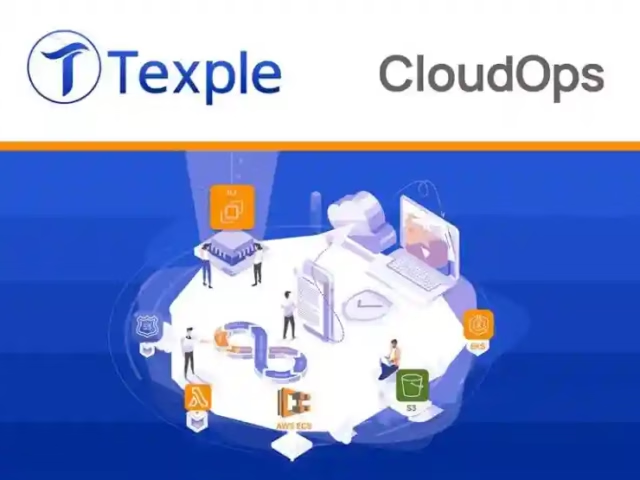
In the modern cloud landscape, ensuring infrastructure visibility, compliance, and performance monitoring is crucial for maintaining operational efficiency. Our CloudOps – Infra Scanning solution is designed to automate AWS infrastructure assessments, generate comprehensive reports, and provide real-time alerting for resource anomalies.

By leveraging AWS Lambda, AssumeRole principles, CloudFormation stacks, and Zabbix monitoring, this solution enables automated scanning of AWS services, including EC2, S3, Load Balancers, EKS, ECS, Lambda, Route 53, and many more. The collected insights are compiled into a structured Excel report, following a color-coded threshold system to highlight potential risks.

Additionally, the solution monitors system health, detecting CPU and memory spikes and triggering real-time alerts to ensure proactive issue resolution.

Key Features
1. Automated AWS Infrastructure Scanning
  • AWS Lambda function executes periodic scans to fetch infrastructure details.
  • AssumeRole mechanism enables secure access to client AWS accounts for scanning.
  • Supports a wide range of AWS services, including:
    • EC2 instances (CPU, Memory, Storage, Security Groups).
    • S3 buckets (Encryption, Public Access, Object Count, Size).
    • Load Balancers (Type, Security, Attached Targets).
    • EKS clusters (Node groups, Scaling Configurations).
    • ECS clusters (Task Definitions, Running Containers).
    • Lambda functions (Execution Time, Triggers, Resource Limits).
    • Route 53 configurations (DNS Health, Record Sets).
2. Color-Coded Excel Reporting for Infrastructure Health
  • Scanned data is automatically compiled into an Excel sheet and stored in an S3 bucket.
  • The report follows a color-coded threshold system for easy risk assessment:
    • βœ… Green – Healthy resources within defined limits.
    • ⚠️ Yellow – Warning status, approaching threshold limits.
    • ❌ Red – Critical status, resources exceeding safe operational limits.
  • Ensures quick identification of potential security and performance risks.
3. Secure Cross-Account Scanning with AssumeRole
  • CloudFormation stack is deployed in client AWS accounts to create a secure IAM role.
  • Our Lambda function assumes this role to access and scan AWS resources without direct access to credentials.
  • Ensures secure, controlled, and compliant infrastructure assessments.
4. Real-Time Alerting & Endpoint Monitoring with Zabbix
  • Zabbix-based monitoring system continuously tracks resource utilization.
  • Alerts are triggered when CPU, memory, or network usage spikes beyond set thresholds.
  • Notifications are sent via email, Slack, or webhook integrations to alert operations teams.
  • Helps in preventing system downtime and optimizing resource utilization.
5. Fully Automated Workflow & Scheduled Scanning
  • Automation-first approach ensures that scanning and reporting are performed without manual intervention.
  • Scheduled Lambda executions keep infrastructure reports up to date.
  • On-demand scanning feature allows for instant resource health checks.
Technical Architecture
1. Workflow Overview
  1. CloudFormation stack is deployed in the client AWS account to create an IAM role with necessary permissions.
  2. The Lambda function assumes the IAM role to fetch infrastructure details securely.
  3. Data is processed and structured into an Excel report with a color-coded status indicator.
  4. The report is uploaded to an S3 bucket for storage and easy access.
  5. Zabbix continuously monitors resource utilization, and alerts are triggered for high CPU, memory, or network spikes.
  6. Alerts are sent via configured channels (Email, Slack, Webhook, etc.) for immediate action.
2. Technology Stack
  • AWS Lambda – Serverless execution for scanning AWS infrastructure.
  • AWS CloudFormation – Automates IAM role creation for cross-account scanning.
  • Amazon S3 – Stores infrastructure reports in Excel format.
  • AWS IAM (AssumeRole) – Provides secure access to client accounts.
  • Python & Pandas – Processes AWS data and generates structured Excel reports.
  • Zabbix – Monitors infrastructure health and triggers real-time alerts.
  • SNS / Email / Slack – Delivers alerts for resource spikes and critical events.
Benefits of CloudOps – Infra Scanning
1. Enhanced Security & Compliance

βœ… Cross-account scanning using AssumeRole ensures secure resource assessment.
βœ… Color-coded risk assessment helps teams quickly identify and mitigate threats.
βœ… Continuous monitoring ensures compliance with security and performance benchmarks.

2. Proactive Resource Optimization

βœ… Early detection of overutilized resources prevents outages.
βœ… Automated threshold-based alerts improve response times.
βœ… Real-time insights allow teams to right-size AWS resources for cost efficiency.

3. Fully Automated & Scalable Solution

βœ… Zero manual intervention required for scanning and reporting.
βœ… Can scale across multiple AWS accounts seamlessly.
βœ… Scheduled & on-demand scans ensure up-to-date infrastructure visibility.

4. Business Impact & Cost Savings

βœ… Reduces downtime risk with proactive alerting.
βœ… Optimizes AWS costs by identifying underutilized resources.
βœ… Ensures compliance adherence, reducing regulatory risks.

Conclusion

Our CloudOps – Infra Scanning solution provides an automated, secure, and scalable approach to monitoring AWS infrastructure health and performance. With Lambda-driven scanning, AssumeRole-based secure access, real-time Zabbix monitoring, and color-coded Excel reports, organizations can gain full visibility into their AWS environment and take proactive actions to maintain system efficiency and security.

Introduction

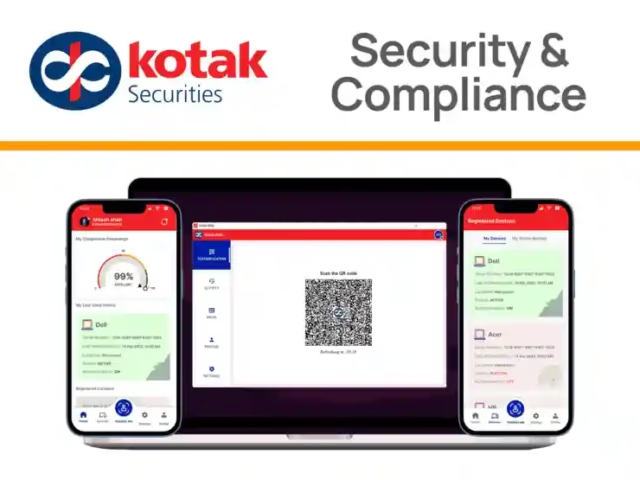
In the fast-evolving financial services industry, security, compliance, and operational efficiency are paramount. Kotak Securities, a leading financial services provider, faced critical challenges in securing terminal access and ensuring that only authorized dealers could operate the system. The absence of a robust verification mechanism not only posed security risks but also impacted the company’s operational efficiency and reputation.

To address these challenges, Texple Technologies developed a custom-built mobile and desktop application that incorporated advanced geolocation tracking, QR code authentication, and secure photo verification. This AI-powered compliance solution significantly enhanced security, reduced unauthorized access, and streamlined dealer verification, ensuring that Kotak Securities maintained the highest operational standards.

Challenges Faced by Kotak Security

Kotak Securities needed a secure and efficient system to regulate access to its trading terminals and prevent unauthorized usage. However, several challenges were limiting their efficiency:

1. Lack of Controlled Terminal Access
  • No proper authentication system to ensure that only authorized dealers could access the terminal.
  • Unauthorized personnel were misusing the system, leading to compliance risks.
  • The absence of real-time monitoring made it difficult to track access violations.
2. Manual & Inefficient Verification Process
  • Time-consuming and error-prone manual verification process.
  • No automated tracking system to validate dealer visits.
  • Inconsistent verification led to inefficiencies and security loopholes.
3. Absence of Accurate Geolocation Tracking
  • No real-time geolocation tracking to ensure that dealers were accessing the system from approved locations.
  • Risk of false dealer check-ins and fraudulent activity.
  • Lack of location data made it difficult to audit visits and track operational efficiency.
4. Compliance & Security Risks
  • The inability to verify authorized users in real time led to potential fraud and non-compliance issues.
  • No multi-factor authentication (MFA) or biometric verification, increasing the risk of identity theft.
  • Compliance violations could lead to financial penalties and damage to brand reputation.
5. Operational Inefficiencies & Lack of Automation
  • Inefficient reporting mechanisms for dealer visits and system usage.
  • Limited data visibility made it hard to audit and optimize operational workflows.
  • Lack of automated tracking and verification led to unnecessary delays in approvals and access control.
Solution Offered by Texple Technologies

To overcome these challenges, Texple Technologies designed and developed a comprehensive mobile and desktop application that leverages AI, geolocation tracking, and biometric authentication to enhance security, automate compliance, and streamline operations.

1. Secure Terminal Access with Multi-Factor Authentication (MFA)
  • Implemented QR code-based authentication to ensure only verified dealers could access the trading terminals.
  • Multi-factor authentication (MFA) combined with biometric login (face ID & fingerprint recognition) for enhanced security.
  • Real-time validation system to prevent unauthorized access attempts.
2. Automated Geolocation Tracking for Dealer Verification
  • Integrated GPS-based geolocation tracking to validate the physical presence of the dealer at the authorized location.
  • Dealers were required to capture a geotagged selfie to confirm attendance.
  • Tamper-proof location tracking ensured that false check-ins were eliminated.
3. QR Code & Photo Verification for Compliance
  • QR code scanning system allowed dealers to quickly verify their identity before accessing terminals.
  • Secure photo capture provided additional authentication, ensuring that only registered personnel could use the system.
  • Encrypted digital records maintained a secure audit trail for regulatory compliance.
4. AI-Powered Compliance Monitoring
  • Implemented AI-driven fraud detection to identify suspicious access patterns.
  • Enabled real-time alerts for unauthorized attempts or unusual activity.
  • Automated compliance reporting system helped the company meet financial regulatory standards effortlessly.
5. Seamless Cross-Platform Accessibility
  • Developed a mobile (Android & iOS) and desktop application to ensure dealers could securely access terminals from different devices.
  • Cloud-based infrastructure allowed for remote monitoring and access control.
  • AWS-powered architecture ensured high availability and reliability.
Technical Architecture & Tech Stack
Technologies Used:
  • Frontend: Flutter for mobile apps, Electron for desktop applications.
  • Backend: .NET Core & Node.js for API services.
  • Database: AWS RDS (PostgreSQL) for secure data storage.
  • Security: End-to-End Encryption, MFA, AWS WAF, AWS Shield.
  • Geolocation & AI: Google Maps API for GPS tracking, AWS SageMaker for fraud detection.
  • CI/CD & Deployment: GitLab CI/CD, AWS Lambda for automation.
Architecture Flow:
  1. User logs in securely using MFA (QR code + Biometric authentication).
  2. The system fetches the geolocation to verify the dealer’s presence at an authorized location.
  3. QR code is scanned, and the dealer captures a photo for identity verification.
  4. AI-driven fraud detection checks for anomalies in access behavior.
  5. Real-time access logs are generated and stored securely in AWS RDS for compliance audits.
  6. Automated alerts are triggered if any unauthorized attempts are detected.
Key Benefits Delivered

With the successful implementation of Kotak Securities compliance and verification solution, Texple Technologies helped the company achieve unmatched security, efficiency, and compliance adherence.

1. Enhanced Security & Access Control

βœ… Strict multi-layer authentication prevented unauthorized access.
βœ… Real-time location validation ensured that only authorized dealers could use the terminal.
βœ… AI-powered fraud detection provided advanced protection against security threats.

2. Streamlined Operations & Improved Efficiency

βœ… Automated verification system eliminated the need for manual checks.
βœ… Faster dealer authentication improved operational speed and reduced downtime.
βœ… Instant QR code scanning & photo verification simplified the process.

3. Regulatory Compliance & Audit Readiness

βœ… Encrypted transaction logs ensured full compliance with financial regulations.
βœ… Real-time compliance monitoring reduced legal risks.
βœ… Automated compliance reports simplified audits and reporting.

4. Seamless User Experience with Cross-Platform Access

βœ… Mobile & desktop compatibility allowed seamless access across different devices.
βœ… User-friendly interface made it easy for dealers to verify themselves.
βœ… Cloud-based solution ensured remote access & secure data storage.

5. Competitive Advantage & Business Growth

βœ… Improved reputation & trust by ensuring only authorized personnel could use the system.
βœ… Reduced fraudulent activities, boosting company credibility.
βœ… Optimized operational efficiency, leading to cost savings & improved service delivery.

Conclusion

By implementing an advanced compliance and verification solution, Kotak Securities successfully transformed its terminal access control and dealer authentication process.

Texple Technologies’ AI-driven security mechanisms, geolocation tracking, and automated compliance system ensured that only verified dealers could access the system, enhancing security, efficiency, and regulatory adherence.

With this cutting-edge solution, Kotak Securities is now equipped with a future-proof infrastructure, empowering them to operate securely, maintain compliance, and optimize operational workflows. πŸš€

Introduction

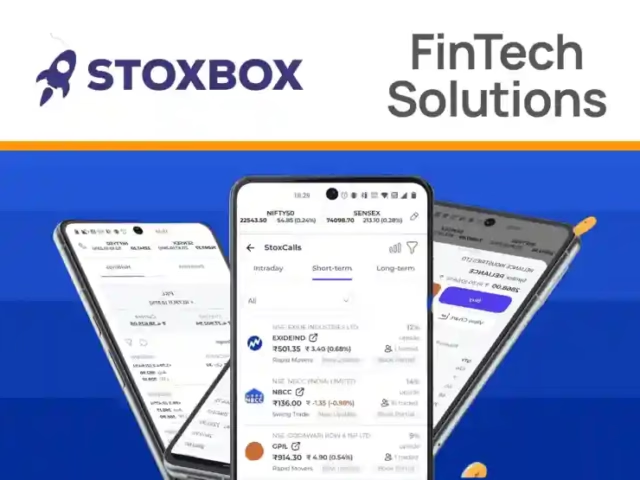
In the fast-paced world of stock trading, technology-driven insights, seamless user experience, and real-time analytics are crucial to staying competitive. StoxBox, a leading stock trading platform, sought to enhance its capabilities by implementing a secure, scalable, and feature-rich trading application.

To achieve this, Texple Technologies, an AWS Partner, collaborated with StoxBox to develop a cutting-edge trading app that integrates AI-powered stock recommendations, real-time user tracking, multi-platform compatibility, and robust security mechanisms. By leveraging AWS Cloud Services and Flutter, StoxBox was able to provide a seamless and intelligent trading experience for its users.

Challenges Faced by StoxBox

As the financial markets evolved, StoxBox needed a modernized platform to cater to its growing user base and maintain its market leadership. However, they faced several challenges:

1. Lack of a Smart Stock Recommendation System
  • The platform lacked an AI-driven recommendation engine to help users make data-backed trading decisions.
  • Users struggled to identify high-potential stocks, leading to missed opportunities.
  • A need for real-time stock analysis to provide actionable insights.
2. Inconsistent User Tracking & Analytics
  • No proper mechanism to track user actions, preferences, and behaviors.
  • Limited analytics resulted in an inability to offer personalized trading suggestions.
  • Lack of user engagement metrics made it difficult to optimize the trading experience.
3. Cross-Platform Compatibility Issues
  • The existing system did not support both mobile and web platforms seamlessly.
  • Users demanded a consistent and responsive UI/UX across multiple devices.
  • Needed an app that could function on iOS, Android, and web with minimal maintenance overhead.
4. Security & Compliance Concerns
  • Sensitive user data and financial transactions required robust security measures.
  • Needed end-to-end encryption, multi-factor authentication (MFA), and fraud detection to prevent cyber threats.
  • Compliance with financial industry regulations was essential to ensure legal adherence.
5. Scalability & Performance Bottlenecks
  • The platform needed to handle high trading volumes, concurrent users, and real-time data updates.
  • Existing infrastructure struggled with sudden spikes in user activity during market fluctuations.
  • Required an auto-scaling solution that could dynamically adjust resources.
Solution Offered by Texple Technologies

To address these challenges, we developed a highly scalable, secure, and AI-powered trading application using AWS Cloud Services and Flutter. The solution included:

1. AI-Driven Stock Recommendation System
  • Integrated machine learning algorithms to analyze market trends and suggest optimal trading strategies.
  • Implemented real-time stock analytics dashboards for instant insights.
  • Personalized recommendations based on user trading history, market conditions, and risk appetite.
2. Real-Time User Tracking & Actionable Insights
  • Deployed AWS Kinesis and AWS Lambda for real-time event tracking and analytics.
  • Enabled personalized trade suggestions using behavior-driven insights.
  • Dashboard with live tracking of user interactions, preferences, and trading patterns.
3. Cross-Platform Compatibility with Flutter
  • Developed a single codebase application using Flutter, ensuring a uniform experience across iOS, Android, and Web.
  • Implemented a highly responsive UI/UX, optimized for traders requiring quick data visualization and execution.
  • Seamless integration with trading APIs for real-time market updates.
4. Enterprise-Grade Security & Compliance
  • End-to-end encryption (AES-256) to protect financial transactions and user data.
  • Implemented multi-factor authentication (MFA) and biometric login for enhanced security.
  • AWS WAF & AWS Shield for DDoS protection and fraud detection mechanisms to prevent unauthorized trading activities.
  • Ensured compliance with SEBI, GDPR, and other financial regulatory standards.
5. Scalable & High-Performance Infrastructure
  • AWS Auto Scaling and AWS ECS were implemented to dynamically scale the platform based on trading volume and user activity.
  • AWS RDS (PostgreSQL) for efficient data storage and Amazon S3 for secure log and document storage.
  • AWS CloudFront & API Gateway to optimize latency and performance for global users.
Technical Architecture & Tech Stack
Technologies Used:
  • Frontend: Flutter (Cross-platform mobile & web app)
  • Backend: .NET Core & Node.js for API services
  • Database: AWS RDS (PostgreSQL) for structured data storage
  • Security: AWS WAF, AWS Shield, Multi-Factor Authentication (MFA), End-to-End Encryption
  • CI/CD: GitLab CI/CD for automated deployment and updates
  • Cloud Infrastructure: AWS Auto Scaling, AWS Lambda, AWS S3, AWS CloudFront, AWS API Gateway
  • AI/ML: AWS SageMaker for AI-based stock recommendations
Architecture Flow:
  1. Users log in securely with MFA and biometric authentication.
  2. The trading dashboard fetches real-time stock data via APIs.
  3. AI-powered stock recommendations are generated based on historical trends & user behavior.
  4. User activities are tracked in real-time, enabling personalized trading suggestions.
  5. AWS Auto Scaling manages resource allocation, ensuring high performance during market fluctuations.
  6. CI/CD pipelines automate deployments, ensuring continuous feature updates and improvements.
Key Benefits Delivered

With the deployment of StoxBox’s next-generation trading platform, Texple helped the company achieve:

1. Enhanced User Engagement & Experience

βœ… Personalized stock recommendations increased user engagement.
βœ… Real-time market updates and AI-powered insights improved decision-making.
βœ… Cross-platform compatibility ensured seamless access on mobile & web.

2. Increased Revenue from Subscriptions

βœ… Introduced secure subscription models, allowing users to access premium trading insights.
βœ… Subscription-based AI-driven recommendations provided high-value insights to traders.
βœ… Improved retention rates with real-time engagement features.

3. Scalable & Resilient Infrastructure

βœ… AWS Auto Scaling ensured zero downtime, even during peak trading hours.
βœ… AWS Lambda reduced infrastructure costs by optimizing resource usage.
βœ… Scalable backend architecture allowed rapid growth without performance bottlenecks.

4. Advanced Security & Compliance

βœ… End-to-end encryption protected financial data and transactions.
βœ… MFA, biometric authentication, and AWS WAF enhanced security against cyber threats.
βœ… Regulatory compliance ensured adherence to financial industry standards.

5. Competitive Edge in the Market

βœ… StoxBox positioned itself as a tech-driven trading leader.
βœ… Faster trade execution, intelligent insights, and seamless UX set the platform apart from competitors.
βœ… Future-ready architecture ensures long-term sustainability and innovation.

Conclusion

Through Texple’s expertise in AWS cloud solutions, Flutter development, and AI-driven analytics, StoxBox successfully transformed its trading experience into a cutting-edge, scalable, and highly secure platform.

By implementing real-time stock recommendations, user tracking, automated CI/CD, and AWS-powered security, StoxBox now delivers an unparalleled trading experience, enabling investors to make smarter financial decisions, trade efficiently, and stay ahead in the market.

With this state-of-the-art solution, StoxBox continues to expand its user base, drive revenue growth, and maintain its competitive edge in the financial industry. πŸš€