


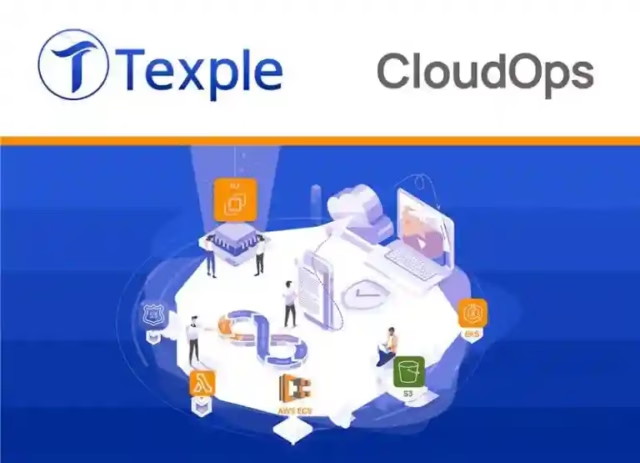
According to the Flexera 2025 State of the Cloud Report, organizations waste 27% of their cloud spend on average. With 84% of enterprises struggling to manage these costs, wasted budget is the #1 challenge in the cloud. Texple eliminates this waste by identifying idle resources and rightsizing your infrastructure.
Code Build
Keeping your eye on the ball while performing a deep dive on the start-up mentality to derive convergence on platform integration.
Keeping your eye on the ball while performing a deep dive on the start-up mentality to derive convergence on platform integration.
















FinOps, or Cloud Financial Operations, is an enterprise management discipline that combines systems, best practices, and culture to maximize business value by enabling engineering, finance, and technology teams to collaborate on data-driven spending decisions.
Enterprises reduce cloud spend by automating resource right-sizing, terminating idle infrastructure, leveraging reserved instances or savings plans, eliminating data egress bloat, and establishing continuous cloud audit policies.
Cloud cost allocation uses precise resource tagging to assign infrastructure expenses directly to specific business units, products, or engineering teams. This enables unit economics tracking—such as cost per user or cost per transaction—allowing executives to make data-driven budget decisions.
We integrate policy-as-code guardrails into your CI/CD pipelines to prevent over-provisioning during deployment. Additionally, we set up continuous cost optimization scanners that flag misconfigured instances, unattached storage volumes, and underutilized clusters automatically.
While DevOps focuses on accelerating software delivery and operational automation, FinOps introduces financial accountability into that process. FinOps ensures engineering teams optimize cloud spending, track cost drivers, and align infrastructure architecture directly with business ROI.
Key FinOps metrics include percentage of tagged cloud resources, effective savings rate, unit cost per transaction/customer, waste ratio (idle vs. active compute), and variance between projected budget and actual monthly spend.
©2022 Texple. All rights reserved.
Are u looking for digital transformation? Or even a comprehensive solution? We are here to help.