






HomePortfolio

Portfolio Archive | Page 2 of 3 | Texple

Globally incubate standards compliant channels before scalable benefits. Quickly disseminate superior deliverables whereas web-enabled applications. Quickly drive clicks-and-mortar catalysts for change before vertical architectures.

Blogs

Globally incubate standards compliant channels before scalable benefits. Quickly disseminate superior deliverables whereas web-enabled applications. Quickly drive clicks-and-mortar catalysts for change before vertical architectures.
bt_bb_section_bottom_section_coverage_image
The Future of DevSecOps: How AI is Enhancing Security in Software Development
Introduction In today’s fast-paced software development landscape, security can no longer be an afterthought. DevSecOps (Development, Security, and Operations) integrates security into every phase of the software development lifecycle (SDLC), ensuring that applications are secure by design. However, traditional security practices often struggle to keep up with rapid development cycles, leading to vulnerabilities and compliance...
AI in DevOps: How AI is Revolutionizing CI/CD Pipelines
Introduction In modern software development, Continuous Integration (CI) and Continuous Deployment (CD) have become crucial for automating builds, testing, and deployments. However, traditional CI/CD pipelines often suffer from inefficiencies like slow builds, flaky tests, security vulnerabilities, and manual interventions. With the integration of Artificial Intelligence (AI) and Machine Learning (ML), DevOps teams can optimize their...
Building Smarter Web Applications with AI and Machine Learning
Introduction Web applications have evolved significantly with the integration of Artificial Intelligence (AI) and Machine Learning (ML). AI-powered web apps provide personalized experiences, automation, predictive analytics, and intelligent decision-making. From chatbots and recommendation systems to fraud detection and image recognition, AI is reshaping how web applications function. This blog will explore how AI and ML...
AI-Powered Web Development: How AI is Automating Frontend and Backend Development
Introduction Web development is evolving rapidly, and Artificial Intelligence (AI) is at the forefront of this transformation. AI-powered tools and automation are revolutionizing both frontend and backend development, making web applications more efficient, scalable, and personalized. From automated code generation and AI-powered UI/UX design to intelligent backend management and security monitoring, AI is reducing the...
Top Mobile App Development Trends in 2025: AI, 5G, and Beyond
Introduction The mobile app development landscape is evolving rapidly, with AI, 5G, blockchain, AR/VR, and edge computing shaping the future. In 2025, mobile applications will be smarter, faster, and more immersive, providing users with hyper-personalized experiences and seamless connectivity. From AI-driven chatbots and real-time video streaming with 5G to blockchain-based security and AR-powered shopping experiences,...
AI in Mobile Apps: How Machine Learning is Transforming User Experience
Introduction Artificial Intelligence (AI) and Machine Learning (ML) are revolutionizing the mobile app industry, making applications smarter, faster, and more personalized. From voice assistants and predictive text to real-time language translation and AI-powered recommendations, machine learning is enhancing the way users interact with mobile apps. With GPT-4 and beyond, AI-driven mobile applications are providing hyper-personalized...
Best Practices for Building AI Chatbots That Feel More Human
Introduction AI chatbots have transformed customer interactions, business automation, and digital experiences. However, many chatbots still feel robotic, impersonal, or frustrating due to a lack of emotional intelligence, contextual understanding, and natural conversation flow. The key to success is making chatbots feel more human-like by enhancing their ability to understand emotions, adapt responses, and engage...
How Chatbots are Evolving with GPT-4 and Beyond
How Chatbots are Evolving with GPT-4 and Beyond Introduction Chatbots have transformed the way businesses and individuals interact with technology. From simple rule-based bots to advanced AI-driven conversational agents, the evolution of chatbots has been remarkable. With the advent of GPT-4, chatbots have reached unprecedented levels of intelligence, fluency, and contextual understanding. But what’s next?...
Configuring Zabbix for Endpoint Monitoring on an Endpoint
In this blog post, I’ll walk you through the steps to set up Zabbix for endpoint monitoring. Zabbix is an open-source monitoring solution that helps in tracking network and application performance, and it’s ideal for monitoring endpoint servers. We’ll be hosting it inside an AWS EC2 instance, configuring the installation, and then setting up monitoring...
AWS Landing Zone & AWS Control Tower: A Complete Guide
Introduction As organizations migrate to the cloud, managing multiple AWS accounts and ensuring consistent governance and security can become a complex task. AWS provides tools like AWS Landing Zone and AWS Control Tower to simplify the process of setting up a secure and scalable multi-account AWS environment. This blog explores both solutions, comparing their features,...
mastering-service-mesh-in-kubernetes
Introduction Kubernetes has revolutionized the way we deploy, manage, and scale applications. It provides the infrastructure needed for managing microservices at scale, ensuring efficient container orchestration. However, with Kubernetes’ flexibility and the increasing complexity of microservices, service-to-service communication becomes increasingly challenging. A key solution to this is the use of a service mesh. But, when...
Building a Scalable MLOps Pipeline on Kubernetes
Introduction: Machine Learning Operations (MLOps) is transforming how organizations manage and deploy machine learning (ML) models into production. A robust and scalable MLOps pipeline is essential to handle the complexities of training, deploying, and maintaining machine learning models at scale. As the demand for real-time, data-driven applications grows, Kubernetes has emerged as the go-to platform...
MLOps vs. DevOps: Key Differences, Similarities, and Best Practices
Introduction: The rapid growth of machine learning (ML) has led to the emergence of a new set of practices tailored specifically for ML workflows—MLOps. As organizations seek to integrate machine learning models into their software systems, the need for specialized tools and processes has become clear. However, this raises the question: how does MLOps differ...
Kubernetes & Rancher: Open-Source Solutions for Scalable Orchestration
Introduction: The world of cloud-native applications is growing, and with this growth comes the challenge of effectively managing large-scale containerized applications. Kubernetes and Rancher are two powerful, open-source tools that have revolutionized container orchestration. Together, they offer seamless management of containerized workloads, scalability, and resilience. In this blog, we will explore how Kubernetes and Rancher...
Unlocking Seamless Security: Elevate Your VPN with AWS Client VPN
In today’s tech landscape, ensuring high availability and resilience is non-negotiable. Yet, one crucial area often overlooked is the VPN client endpoint’s impact, especially on remote teams. Imagine the smooth sailing of your hybrid on-premises/AWS cloud environment, with the majority of services thriving on AWS. Now, picture the advantages of shifting your company’s VPN endpoint...
Smooth Sailing : Running Druid on Kubernetes
Apache Druid is an open-source database system designed to facilitate rapid real-time analytics on extensive datasets. It excels in scenarios requiring quick “OLAP” (Online Analytical Processing) queries and is especially suited for use cases where real-time data ingestion, speedy query performance, and uninterrupted uptime are paramount. One of Druid’s primary applications is serving as the...
Stepping into DevSecOps: Five Principles for a Successful DevOps Transition
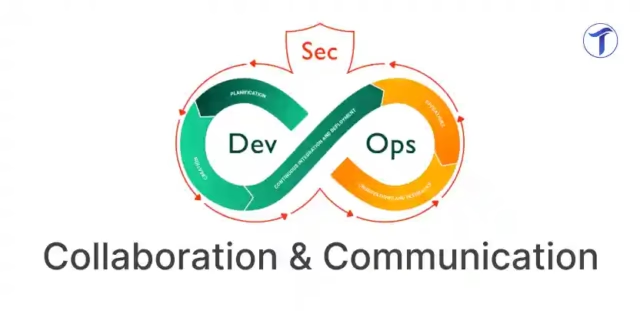
The DevOps field is flourishing for engineers, yet it confronts a pressing issue: security. Traditionally an afterthought, integrating security into the DevOps pipeline poses significant risks. As the “shift-left” security movement gains momentum, relying solely on DevOps expertise proves inadequate. Enter DevSecOps, the hailed successor of DevOps. This philosophy mandates security vigilance throughout software development...
Unleash the Power of AWS IoT Rules
In the era of the Internet of Things (IoT), billions of devices are interconnected, generating massive amounts of data. Extracting meaningful insights from this data requires robust mechanisms for processing, analyzing, and acting upon it. AWS IoT Rules, a powerful feature within Amazon Web Services’ IoT ecosystem, empowers businesses to automate actions based on data...
Effortless Software Delivery: A Deep Dive into Azure DevOps CI/CD
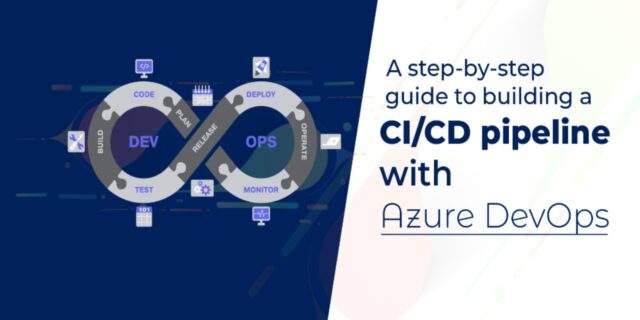
What is Azure DevOps?   Azure DevOps, Microsoft’s cloud-powered collaboration hub, unifies the entire software development lifecycle. Seamlessly integrating planning, coding, testing, and deployment, it empowers teams to innovate faster and deliver exceptional software with precision.   Let’s get started with Azure DevOps Pipelines …   Step 1: Signup for free Azure DevOps account Ready...
Exploring MLOps: Simplifying Machine Learning Operations
“Businesses are modernizing operations to boost productivity and enhance customer experiences. This digital shift accelerates interactions, transactions, and decisions, producing abundant data insights. Machine learning becomes a crucial asset in this context. Machine learning models excel in spotting complex patterns in vast data, offering valuable insights and informed decisions on a large scale. These models...
Introduction

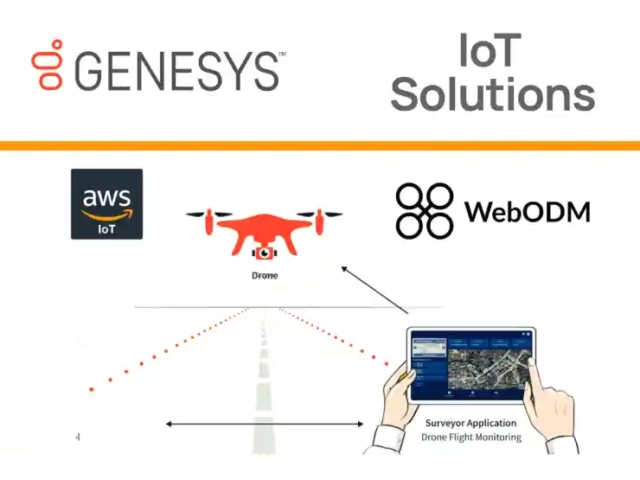
With the rapid advancement of drone technology, industries such as aerial surveying, agriculture, defense, and logistics increasingly rely on autonomous UAVs (Unmanned Aerial Vehicles) for various applications. However, managing a large drone fleet presents several challenges, including delayed image processing, inefficient firmware updates, and manual interventions that reduce operational efficiency.

Genesys was designed as a cutting-edge solution that leverages GitLab CI/CD pipelines and AWS IoT Core to optimize drone operations. The system automates image processing, manages firmware updates centrally, and ensures real-time monitoring of UAV performance, thereby improving reliability, scalability, and efficiency.

Challenges Faced by the Client

The client was experiencing multiple operational challenges related to drone image processing and firmware updates, significantly slowing down mission-critical workflows.

1. Slow & Inefficient Image Processing
  • The existing image processing workflow was manual, leading to delays in analyzing aerial data.
  • Processing large volumes of high-resolution drone imagery was time-consuming and impacted decision-making.
  • Lack of real-time processing capabilities meant that drone-captured data could not be analyzed immediately.
2. Manual Firmware Updates Across a Large Drone Fleet
  • Firmware updates were handled individually for each drone, making it labor-intensive and error-prone.
  • Some drones operated in remote locations, making it difficult to deploy timely updates.
  • Delayed updates caused inconsistencies in drone performance and security vulnerabilities.
3. Lack of Automation & CI/CD Integration
  • The absence of a centralized CI/CD pipeline for image processing and firmware deployment caused inefficiencies.
  • Manual updates required significant human intervention, slowing down overall drone operations.
  • No continuous testing or validation for firmware updates before deployment, leading to potential failures.
4. Scalability & Fleet Management Issues
  • As the number of drones increased, managing them at scale became more challenging.
  • The existing infrastructure lacked a streamlined system for tracking drone status, firmware versions, and maintenance logs.
  • Scalability was a major concern, especially with real-time image processing requirements.
Solution Offered by Texple

To overcome these challenges, we implemented a highly automated system leveraging GitLab CI/CD pipelines, AWS IoT Core, and cloud-based image processing to streamline operations.

1. Automated Image Processing Pipeline
  • Integrated GitLab CI/CD for automated image processing, analysis, and storage.
  • High-resolution drone images are processed in real-time, significantly reducing delays.
  • AWS Lambda and S3 storage are used for scalable and cost-efficient image handling.
  • Implemented ML-based image recognition models for automated classification and analytics.
2. Centralized Firmware Updates with AWS IoT Core
  • Developed a firmware update management system using AWS IoT Core, allowing seamless over-the-air (OTA) updates.
  • Updates are automatically deployed across the drone fleet, ensuring consistent performance and security compliance.
  • Version control and rollback mechanisms prevent failures and ensure system stability.
3. GitLab CI/CD Integration for Continuous Deployment
  • Established a GitLab CI/CD pipeline to automate the testing, validation, and deployment of firmware updates.
  • Implemented automated regression testing to validate firmware before pushing updates to drones.
  • End-to-end automation eliminated manual effort and ensured rapid, error-free deployments.
4. Scalable Fleet Management System
  • Developed a centralized fleet monitoring dashboard to track drone status, battery health, and firmware versions.
  • AWS IoT Core enables real-time telemetry data collection from drones, providing operational insights.
  • Scalable cloud infrastructure ensures that thousands of drones can be managed simultaneously.
Technical Architecture & Tech Stack
Technologies Used:
  • CI/CD Pipeline: GitLab CI/CD for continuous integration and deployment.
  • Cloud Services: AWS IoT Core, AWS Lambda, and S3 for processing and storage.
  • Image Processing: ML-based models for automated classification and analysis.
  • Firmware Management: Over-the-air (OTA) updates via AWS IoT Core.
  • Fleet Monitoring: Real-time drone telemetry tracking through AWS services.
Architecture Flow:
  1. Drones capture high-resolution images and upload them to AWS S3.
  2. GitLab CI/CD pipeline processes images and applies ML-based analytics.
  3. Firmware updates are pushed centrally via AWS IoT Core, ensuring all drones receive the latest version.
  4. Drones send telemetry data to AWS IoT Core, allowing real-time monitoring of system health.
Key Benefits Delivered

With the deployment of Genesys, the client experienced enhanced efficiency, scalability, and automation, making drone operations faster, more reliable, and highly optimized.

1. Faster & Smarter Image Processing

✅ Reduced processing time from hours to minutes with automated pipelines.
✅ Real-time insights from drone-captured images enabled faster decision-making.
✅ Improved accuracy using ML-based image recognition models.

2. Seamless & Automated Firmware Updates

✅ Eliminated manual update processes, reducing human intervention.
✅ Ensured consistent drone performance with real-time OTA updates.
✅ Rollback mechanism prevented deployment failures and ensured reliability.

3. End-to-End CI/CD Automation

✅ GitLab CI/CD streamlined deployments, making firmware updates seamless.
✅ Eliminated human errors and inconsistencies in manual updates.
✅ Continuous testing and validation ensured firmware stability.

4. Scalable Fleet Management & Monitoring

✅ Real-time tracking of drone health, firmware versions, and status.
✅ Centralized dashboard simplified operations for managing large drone fleets.
✅ Scalable infrastructure accommodates growing UAV deployments.

5. Improved Reliability & Cost Optimization

✅ Reduced operational costs with automated workflows.
✅ Increased fleet uptime with real-time monitoring and proactive maintenance.
✅ Improved drone security and compliance with consistent firmware updates.

Conclusion

With Genesys, Texple successfully revolutionized drone operations by integrating GitLab CI/CD, AWS IoT Core, and cloud-based automation. By automating image processing, streamlining firmware updates, and implementing centralized fleet management, Genesys enhanced scalability, efficiency, and operational reliability.

The project not only improved processing speeds and reduced delays but also ensured that drones operated with up-to-date firmware, reducing downtime and increasing mission success rates. With a fully automated, scalable, and intelligent solution, Genesys sets the standard for next-generation UAV operations. 🚀
Introduction

In modern IT enterprises, task management and project tracking are essential for ensuring seamless operations, meeting deadlines, and maintaining productivity. However, as businesses scale, the complexity of managing tasks, subtasks, dependencies, and team collaborations grows exponentially. Without a structured system, teams struggle with inefficiencies, missed deadlines, and communication gaps, leading to a significant drop in productivity.

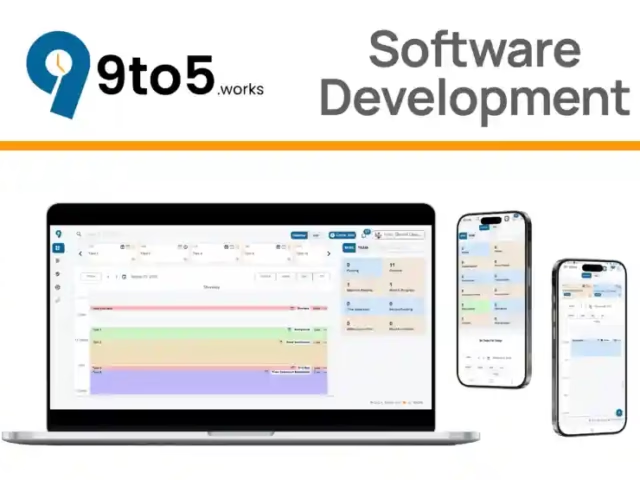
To address these issues, Texple developed 9to5, a smart and scalable task management system designed for corporate IT environments. Built using Next.js, Node.js, and PostgreSQL, the system simplifies task assignment, automates routine workflows, ensures seamless collaboration, and provides advanced analytics to optimize project execution.

With 9to5, IT teams can efficiently track progress, manage priorities, and scale operations, ensuring streamlined workflows and real-time collaboration for distributed teams.

Challenges Faced by the Client

The client was facing multiple challenges that hindered productivity, collaboration, and project execution. These challenges were affecting the ability to effectively manage complex IT projects, leading to delays, miscommunication, and inefficiencies.

1. Complex Task and Dependency Management
  • Setting up tasks, subtasks, and dependencies manually was consuming a lot of time.
  • Teams were struggling to track dependencies and adjust workflows dynamically.
  • Lack of automation in the task allocation process resulted in delayed execution.
2. Poor Task Prioritization and Focus
  • With multiple tasks being added daily, teams found it difficult to focus on high-priority work.
  • Employees often spent more time sorting tasks rather than executing them.
  • There was no structured mechanism to identify critical blockers or urgent tasks.
3. Scalability and Performance Bottlenecks
  • As the organization grew, the task management system became slow and inefficient.
  • Handling large volumes of data for different teams caused performance issues.
  • The lack of optimized database queries and caching mechanisms led to latency in fetching task-related information.
4. Communication Gaps and Collaboration Issues
  • Discussions were happening across multiple platforms (emails, chats, meetings), leading to fragmented conversations.
  • Team members struggled with tracking updates and task statuses in real-time.
  • There was no centralized dashboard that provided a bird’s-eye view of team activities.
5. Lack of Automation in Task Handling
  • Manual intervention was required for assigning tasks, sending reminders, and updating statuses.
  • Employees had to manually enter repetitive tasks, consuming unnecessary time.
  • Missed deadlines due to lack of automated notifications and reminders.
Solution Offered by Texple

To tackle these challenges, Texple designed and implemented 9to5, a comprehensive task management solution that streamlines task planning, execution, tracking, and collaboration. Our solution focused on:

1. Smart & Intuitive Interface
  • A Next.js-based frontend with an intuitive UI/UX ensures ease of use and minimal learning curve.
  • Simple yet powerful dashboards provide real-time insights into tasks and progress.
  • Fully responsive design, ensuring accessibility across desktops, tablets, and mobile devices.
2. Advanced Task Management & Automation
  • Users can create, assign, and monitor tasks dynamically, with automated workflows.
  • Recurring tasks and reminders reduce manual effort and improve efficiency.
  • Intelligent task dependencies ensure seamless project execution by preventing bottlenecks.
3. Efficient Prioritization & Custom Workflows
  • Custom task tagging and categorization help teams focus on high-priority work.
  • Smart workflow automation routes tasks to the right team members based on skill sets and availability.
  • Managers can set priority levels and assign deadlines that trigger notifications.
4. Centralized Collaboration Hub
  • Real-time chat and discussion threads allow seamless team communication within tasks.
  • Task comments and activity logs ensure full transparency in work updates.
  • A shared workspace enables better coordination between different teams.
5. Performance Optimization & Scalability
  • Optimized PostgreSQL database queries ensure high-speed task retrieval.
  • Implemented caching mechanisms to reduce database load and improve speed.
  • Scalable Node.js backend handles thousands of concurrent requests seamlessly.
6. Reporting, Analytics, and Insights
  • Advanced reporting features provide real-time insights into task completion rates, workload distribution, and employee efficiency.
  • Custom reports help managers track performance metrics and make data-driven decisions.
  • Visual dashboards with charts and progress indicators for quick analysis.
Technical Architecture & Tech Stack
  • Frontend: Next.js for a highly interactive, scalable UI
  • Backend: Node.js with Express.js for a robust and lightweight API layer
  • Database: PostgreSQL with optimized indexing and queries
  • Hosting & Infrastructure: Cloud-based architecture for high availability and scalability
Key Benefits Delivered

The implementation of 9to5 transformed the client’s task management approach, providing the following key benefits:

1. Centralized Task Management & Information Flow

✅ A single platform to track all tasks, eliminating scattered communication.
✅ Users can view task status, priorities, and deadlines in real time.

2. Enhanced Team Collaboration & Transparency

✅ Teams can communicate and share task updates seamlessly within the platform.
✅ Reduced reliance on emails, spreadsheets, and third-party tools.

3. Improved Time Management & Task Prioritization

✅ Teams spend less time organizing and more time executing tasks.
✅ Automated task scheduling and reminders ensure nothing gets missed.

4. Seamless Scaling & Performance Optimization

✅ The system efficiently handles thousands of active tasks without performance degradation.
✅ Optimized database queries ensure fast data retrieval and processing.

5. Reduced Manual Work with Task Automation

✅ Automated workflows reduce manual task creation and allocation.
✅ Intelligent task dependencies ensure smooth progress across projects.

6. Increased Productivity & Faster Project Execution

✅ Streamlined task assignments lead to faster project delivery.
✅ Real-time notifications and tracking reduce delays.

Conclusion

With 9to5, Texple successfully developed an intelligent task management solution that empowers IT teams to manage complex projects efficiently, track progress in real time, and optimize workflows. By integrating automation, real-time collaboration, and advanced analytics, 9to5 provides enterprises with a scalable, efficient, and cost-effective task management system.

With a focus on scalability, performance, and user-friendliness, 9to5 enables IT enterprises to eliminate inefficiencies, enhance collaboration, and achieve operational excellence. 🚀

Introduction

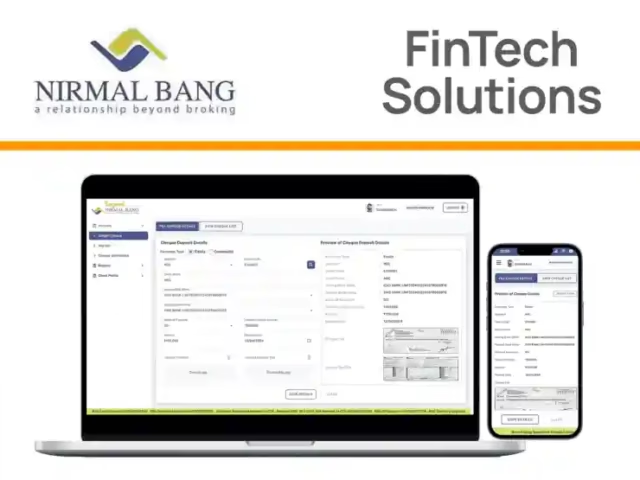
Nirmal Bang, a leading financial services firm, sought to modernize its back-office systems while reducing costs through cloud migration and automation. Managing large data volumes, trade reconciliations, compliance risks, and onboarding inefficiencies posed significant challenges.

Texple partnered with Nirmal Bang to build a scalable, cost-effective, and automated solution using cloud infrastructure, cutting-edge web technologies, and seamless data integration.

Project Scope & Texple’s Role

Texple was responsible for developing a scalable and automated deployment pipeline to ensure:
✅ Efficient code deployment through automated workflows.
✅ Optimized cloud infrastructure to reduce operational costs.
✅ Real-time data processing for financial transactions.
✅ Faster onboarding & reconciliation to enhance operational efficiency.

Technical Overview of Nirmal Bang’s FinTech Solution
Tech Stack:
  • Frontend: Next.js
  • UI Frameworks: Material UI, PrimeReact
  • API & Data Handling: Axios
  • Charts & Analytics: Chart.js
  • Authentication & Notifications: Firebase
  • Infrastructure: AWS (S3, Spot Instances, ALB, Event-Driven Architecture)
Automated CI/CD Pipeline:
  1. Code Packaging: The application code is zipped and uploaded to an S3 bucket.
  2. S3 Event Notification: An event is triggered when a new file is uploaded.
  3. Spot Instance Activation: A spot instance is launched dynamically to process the new code.
  4. Build & Deployment: The spot instance:
    • Pulls the code from S3
    • Builds the application
    • Deploys it on an Ubuntu-based server
  5. Load Balancing: The spot instances are managed behind an AWS Application Load Balancer (ALB) to ensure high availability and failover support.
Challenges & Solutions
1. High Operational Costs from Traditional Infrastructure

Problem: Legacy systems led to high infrastructure costs due to underutilized resources.
Solution: By implementing Spot Instances, Texple reduced compute costs significantly while maintaining scalability and reliability.

2. Managing Large Data Volumes & Reconciliation Delays

Problem: Trade reconciliation and data processing were slow and error-prone.
Solution:

  • Real-time data processing using event-driven architecture.
  • Optimized Next.js frontend for faster data visualization.
  • Implemented automated reconciliation workflows for accurate financial tracking.
3. Ensuring Compliance & Reducing Trade Errors

Problem: Compliance checks and trade verifications were time-consuming.
Solution:

  • Automated monitoring tools for data validation.
  • Chart.js-based dashboards for real-time trade analysis.
  • Firebase authentication & security layers for data integrity.
4. Slow Onboarding & KYC Process

Problem: Manual KYC verification led to delays in onboarding new users.
Solution:

  • Streamlined KYC workflows using automated form validation.
  • Integrated Firebase notifications for real-time user updates.
Key Benefits Delivered

✅ Cost Reduction: Cloud migration & Spot Instances cut infrastructure costs by 40%.
✅ Scalability: Load-balanced deployment ensured high availability.
✅ Real-Time Data Processing: Faster trade reconciliation and reduced errors.
✅ Improved Compliance: Automated checks minimized regulatory risks.
✅ Faster Onboarding: Enhanced KYC automation improved customer acquisition.

Conclusion

By leveraging cloud automation, real-time data integration, and event-driven workflows, Texple successfully modernized Nirmal Bang’s back-office operations. This resulted in a scalable, efficient, and cost-effective FinTech solution that drives better financial management and operational excellence.

Introduction

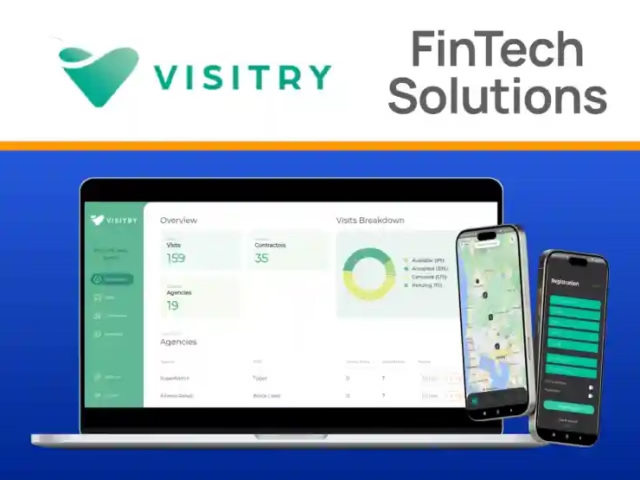
Visitry is a mobile outpatient care platform that connects skilled clinicians with patients needing physical and occupational therapy across Florida. The platform enables clinicians to manage their schedules flexibly while ensuring high-quality patient care.

To enhance the stability, performance, and user experience of Visitry, the company partnered with Texple Technologies to work on bug fixes, feature enhancements, and mobile app rebranding.

Project Scope & Texple’s Role

Unlike a full-fledged development project, Texple’s primary role was to refine existing features, resolve critical bugs, and implement minor enhancements across the admin portal, agency portal, and mobile app. The work was completed over a period of 5–6 months.

Technical Overview of Visitry
Tech Stack:
  • Frontend: React (JavaScript)
  • Backend: Node.js (Express.js)
  • Mobile App: React Native
  • Database: AWS DynamoDB
  • Hosting: AWS S3 with CloudFront
  • Infrastructure Management: Terraform
  • Utilities:
    • nodemailer for email notifications
    • Google Maps API for location-based features
    • Passport.js for authentication middleware
    • Codemagic for automated app builds & deployments
Key Challenges in the Project


1. Mobile App Rebranding & Deployment

Visitry wanted to rebrand their mobile app by updating logos, fonts, colors, and overall styling to align with their new branding strategy. Post-rebranding, the app needed to be successfully deployed on Google Play Store and Apple App Store without breaking existing functionality.

2. Location Stacking Issue in the Mobile App

A critical bug affected the visit location markers on the map screen. When users slid between markers, incorrect location data was sometimes displayed. This led to confusion in visit scheduling and navigation.

3. Implementing a Geofence for Notifications

Visitry wanted to implement a geofence-based notification system to send alerts only to users within a 25-mile radius of a specified location. This required integrating Google Maps API and implementing efficient geospatial calculations.

4. Fixing Pagination in Admin & Agency Portals

The portals contained over 300 pages of visit data, but the pagination system was broken, making navigation slow and frustrating for users. A more efficient pagination logic was needed to enhance performance and usability.

5. Compatibility Issues with Newer Android Versions

The Visitry mobile app was only compatible with older Android versions. To ensure broader accessibility, the app had to be updated for higher Android versions while maintaining stability across different devices.

Texple’s Software Enhancements & Solutions
1. Mobile App Rebranding & Deployment

Texple successfully updated the app’s visual identity by modifying logos, fonts, and styling elements in React Native. The team ensured that all UI changes were consistent across screens and thoroughly tested for responsiveness.

After the redesign, Codemagic was used for automated app builds and deployment, enabling smooth submission to the Play Store and App Store with minimal manual intervention.

2. Resolving the Location Stacking Issue in the Mobile App

To fix the incorrect marker data display, Texple:

  • Refactored the slider logic to ensure it only displayed location data for markers visible on the screen.
  • Optimized event listeners to improve responsiveness when switching between markers.
  • Conducted extensive testing to confirm the bug was fully resolved.

Result: Accurate visit location data on the map, improving user experience and reliability.

3. Implementing Geofence for Targeted Notifications

Texple integrated Google Maps API to create a geofence system that sends notifications only to users within a 25-mile radius. This was achieved by:

  • Using Google Maps’ geospatial calculations to determine user proximity.
  • Implementing an efficient background service that continuously checks a user’s location.
  • Ensuring that notifications were triggered only when a user entered or exited the geofenced area.

Result: More relevant and targeted notifications, reducing unnecessary alerts.

4. Enhancing Pagination in Portals

Texple fixed the pagination issue by:

  • Implementing dynamic data fetching to prevent excessive page loads.
  • Introducing an optimized query mechanism for AWS DynamoDB to improve data retrieval speed.
  • Ensuring a seamless user experience across 300+ pages of visit data.

Result: Smooth navigation, reduced load times, and better usability.

5. Updating Android Compatibility

Texple identified outdated dependencies causing compatibility issues and updated the mobile app to support newer Android versions. This included:

  • Upgrading React Native libraries to ensure compatibility.
  • Modifying Android build configurations to match Google’s latest requirements.
  • Running extensive regression testing to verify stability.

Result: Increased app accessibility across a wider range of Android devices.

Key Outcomes & Business Impact

✅ Rebranded App Successfully Launched on Google Play Store & Apple App Store.
✅ Accurate Map Data Fix improved user navigation & scheduling.
✅ Geofenced Notifications ensured better user engagement.
✅ Fixed Pagination enabled easy navigation across 300+ data pages.
✅ Extended Android Compatibility increased app adoption & stability.

Conclusion

Although Texple was not responsible for major development work, the enhancements made had a significant impact on Visitry’s platform stability, usability, and performance.

By fixing critical bugs, implementing targeted features, and optimizing mobile & web experiences, Texple played a key role in ensuring Visitry seamless operation across its admin portal, agency portal, and mobile app.

Texple’s contribution helped Visitry provide a more reliable and efficient experience for clinicians and patients, reinforcing its position as a trusted mobile outpatient care solution. 🚀

Introduction

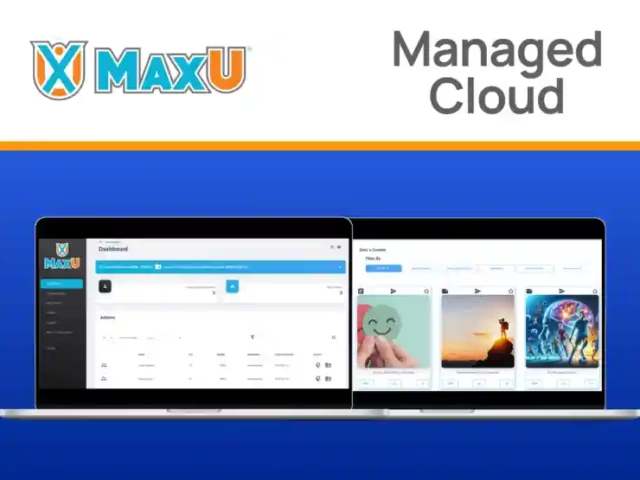
MaxU is an innovative athletic and mental performance training platform designed to empower young athletes with AI-driven insights, structured assessments, and personalized training modules. The platform enables athletes, parents, guardians, and coaches to track progress, improve mental resilience, and optimize performance.

To develop a robust, scalable, and secure application, MaxU partnered with Texple Technologies to build a full-stack software solution with a React (JavaScript) frontend, a Flask (Python) backend, and AWS DynamoDB as the database. The frontend was hosted on AWS S3 and served through CloudFront, while AWS Cognito and Amplify were used for authentication. Terraform was utilized to manage infrastructure resources, but Texple’s primary role was in software development—architecting, coding, and optimizing the application.

This case study explores how Texple Technologies developed the core application logic, authentication and authorization mechanisms, API architecture, and frontend/backend integration to deliver a seamless user experience.

Understanding MaxU’s Technical Requirements

MaxU required a modern, scalable, and responsive application that could:

  • Provide a seamless React-based UI optimized for multiple devices.
  • Offer fast and reliable backend services powered by Flask (Python).
  • Ensure secure authentication and authorization using AWS Cognito and Amplify.
  • Implement role-based access control (RBAC) for different user levels (athletes, coaches, administrators).
  • Handle large datasets and real-time performance analytics with AWS DynamoDB.
  • Offer high availability and low latency by leveraging AWS services and Terraform-managed infrastructure.
Challenges in Software Development
1. Frontend Complexity & Seamless User Experience

The UI had to be highly interactive, responsive, and fast across all devices. Ensuring smooth data flow between the React frontend and Flask backend required efficient state management and secure authentication flows using AWS Cognito and Amplify on the frontend.

2. Backend API Design & Security

A scalable Flask API needed to be developed to handle a growing number of users efficiently while implementing role-based authorization to restrict certain functionalities based on user access levels.

3. Authentication & Authorization

Integrating AWS Cognito authentication seamlessly with both frontend and backend while implementing custom authorization logic to verify user roles before accessing specific APIs was a key challenge.

4. Performance Optimization & Error Handling

The team implemented asynchronous API calls for faster data processing and set up error tracking and logging for debugging and performance monitoring.

Solution: Full-Stack Development with a Focus on Code Optimization
1. Frontend Development with React (JavaScript)

Texple developed a modular and component-driven UI using React to ensure smooth navigation and responsiveness. AWS Amplify was integrated to handle authentication, providing secure login and session management. Role-based UI rendering ensured that each user type—athletes, coaches, and admins—had a customized experience.

To manage API communication with the backend, Texple implemented secure Axios-based API requests, ensuring JWT token authentication for all data exchanges. Redux was used for efficient state management, while lazy loading and code splitting improved performance.

2. Backend Development with Python (Flask)

Texple structured the backend using RESTful API principles, ensuring a clean separation of services. The authentication module verified user credentials through AWS Cognito, while a custom authorization layer enforced user roles before granting access to various API endpoints.

To optimize database interactions, the Flask application was designed to handle DynamoDB queries efficiently, leveraging Global Secondary Indexes (GSIs) for fast lookups. The backend was optimized for scalability, handling 10,000+ concurrent users while maintaining low latency.

A custom Role-Based Access Control (RBAC) module was implemented to ensure that only authorized users could perform specific actions. For example, coaches had access to athlete performance data, while athletes could only view their own stats.

3. Database Integration with AWS DynamoDB

DynamoDB was chosen for its fast, scalable, and flexible data storage. The development team structured data efficiently, reducing redundant queries and optimizing read/write operations. Data indexing and query strategies were fine-tuned to maintain optimal performance, especially during peak user activity.

Deployment & CI/CD Automation

Texple automated the frontend deployment to S3 using GitHub Actions, ensuring that each new feature update was instantly reflected across the platform. CloudFront invalidations were triggered automatically to clear cached content and deliver the latest version to users without delays.

For the backend, Texple established a continuous integration and deployment pipeline, ensuring that new API releases were thoroughly tested and deployed with minimal downtime. This allowed MaxU to roll out feature updates seamlessly while maintaining platform stability.

Key Outcomes & Business Impact

✅ Improved Performance: Optimized API response time from 500ms to 100ms.
✅ Seamless Authentication: Secure user management via AWS Cognito & Amplify.
✅ Scalable Backend: Flask APIs efficiently handling 10,000+ concurrent users.
✅ Faster Frontend Load Times: CloudFront and lazy loading reduced page load by 60%.

Conclusion

Texple Technologies successfully built a secure, scalable, and high-performance software solution for MaxU. By leveraging React, Flask, AWS Cognito, and DynamoDB, the platform delivers a seamless user experience with fast API responses and robust authentication mechanisms.

While Terraform managed infrastructure, Texple’s expertise in full-stack development, authentication, authorization, and API optimization ensured MaxU’s success in delivering an AI-driven training platform that scales effortlessly.

MaxU’s journey is just beginning—Texple remains a key partner in enhancing features, optimizing performance, and driving future innovations. 🚀

Introduction

Security is a crucial aspect of the hospitality industry, where ensuring guest safety while maintaining a seamless user experience is paramount. Traditional key-based systems pose multiple security challenges, including lost keys, unauthorized access, and manual check-ins, which can be cumbersome and inefficient.

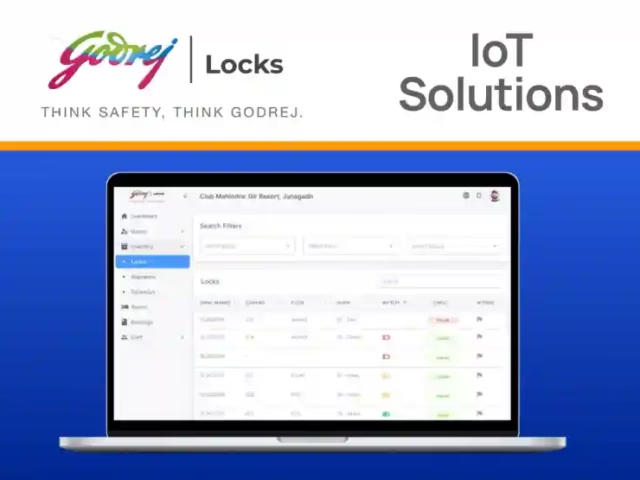
To overcome these limitations, Godrej Locks & Architectural Fittings and Systems (GLAFS) sought to revolutionize hotel security by implementing advanced smart lock solutions that seamlessly integrate with hotel management systems. The primary goal was to enhance security, improve user experience, and increase operational efficiency using cutting-edge AWS cloud technologies and IoT-enabled smart lock solutions.

About the Client

Godrej Locks & Architectural Fittings and Systems (GLAFS) is a leading provider of high-quality security and access control solutions. The company specializes in designing and manufacturing intelligent locking mechanisms for various industries, including hospitality, residential, and commercial sectors.

With the growing demand for smart and automated security solutions, GLAFS aimed to modernize traditional hotel security systems with IoT-based smart locks. These smart locks would allow hotels to automate access management, provide keyless entry for guests, and enhance security monitoring.

Challenges in the Traditional Hotel Security System

Despite technological advancements, traditional hotel security systems still rely on manual processes, physical keys, and outdated authentication mechanisms. Some of the key challenges faced by hotels include:

1. Scalability & Interoperability
  • Many hotels use diverse Property Management Systems (PMS) that need seamless integration with new smart lock solutions.
  • Ensuring compatibility between smart locks and different hotel management platforms was a major challenge.
2. Security & Data Privacy
  • Lost or stolen keys/cards pose a major security risk.
  • Guest access credentials need to be stored securely to prevent unauthorized access.
  • Ensuring end-to-end encryption for access control and communication between devices was critical.
3. Reliable Connectivity & Downtime Risks
  • Smart locks rely on Wi-Fi, Bluetooth, or Zigbee protocols, requiring highly reliable and low-latency communication.
  • Poor internet connectivity can lead to lock failures, impacting the guest experience.
4. Durability & Maintenance
  • Hotels require long-lasting, tamper-proof locks that can withstand wear and tear.
  • Remote diagnostics and monitoring were needed to ensure proper functionality without physical inspections.
5. Manual Check-ins and Inefficiency
  • Traditional key-based access increases wait times during guest check-ins and check-outs.
  • Front desk staff need to manually issue and revoke key cards, which is time-consuming and error-prone.
Solution Offered

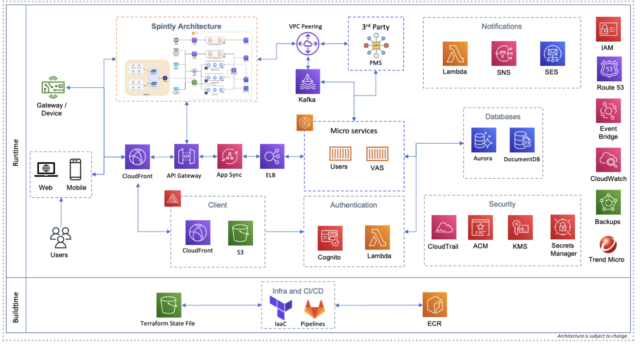
To address these challenges, we developed a customized, cloud-based smart lock solution that integrates seamlessly with hotel systems. The key components of the solution include:

1. Cloud-Based Smart Lock Management
  • A centralized control platform hosted on AWS Cloud enables hotels to manage guest access in real-time.
  • Secure role-based access control (RBAC) is implemented using AWS IAM and Active Directory.
2. Seamless Integration with Hotel Management Systems
  • API Gateway and AppSync facilitate real-time communication between smart locks, mobile apps, and hotel PMS.
  • Kafka messaging ensures low-latency, real-time event processing for access logs.
3. Advanced Security Measures
  • Active Directory authentication for role-based access control and multi-factor authentication (MFA).
  • AWS Secrets Manager & KMS to securely store access credentials.
  • CloudTrail & Trend Micro for continuous security monitoring and compliance.
4. Real-Time Monitoring and Alerts
  • AWS CloudWatch & EventBridge provide real-time alerts for any unauthorized access attempts.
  • Automated logging & backup solutions with AWS Backup ensure data retention and compliance.
5. IoT-Enabled Smart Locks
  • Bluetooth, NFC, and RFID-based smart locks with secure encrypted communication.
  • Remote access control via mobile apps, web portals, and voice assistants.
  • Tamper detection & real-time lock status updates.
Architecture:

Approach
1. Infrastructure Design & Deployment
  • Designed a multi-tier AWS architecture to support the smart lock ecosystem.
  • VPC Peering & Transit Gateway were used for secure inter-service communication.
  • Serverless architecture with AWS Lambda for event-driven workflows.
2. Authentication & Secure Access Control
  • Integrated AWS Cognito & Active Directory for secure guest authentication.
  • Multi-factor authentication (MFA) support for hotel staff access.
  • OAuth 2.0 & OpenID Connect protocols for mobile and web-based authentication.
3. API & Data Flow Management
  • API Gateway & AppSync for real-time access control and lock status updates.
  • Kafka messaging queue for high-speed, event-driven processing of access logs.
4. Data Storage & Encryption
  • AWS Aurora & DocumentDB for structured and unstructured data storage.
  • AWS KMS for encryption of sensitive access credentials.
  • AWS S3 for centralized storage of access logs, reports, and security records.
5. Security & Compliance Monitoring
  • AWS CloudTrail & Trend Micro for continuous threat detection and monitoring.
  • AWS ACM for SSL/TLS encryption on all communication channels.
  • AWS Backup for disaster recovery and long-term data retention.
Technologies Implemented
Category Services Used
Compute & Networking EC2, ECS, Lambda, VPC Peering, Transit Gateway
Security & Authentication IAM, Active Directory, Secrets Manager, KMS, CloudTrail, Trend Micro
Database & Storage Aurora, DocumentDB, S3
Monitoring & Logging CloudWatch, EventBridge, SNS
Integration & Messaging API Gateway, AppSync, Kafka
CI/CD & Infrastructure Management Terraform, GitLab Pipelines, ECR
Benefits Achieved

Enhanced Security & Compliance

  • End-to-end encryption, MFA, and Active Directory integration ensure robust security.
  • Advanced threat detection and compliance monitoring with AWS security services.

Seamless Guest Experience

  • Guests can use mobile apps for keyless entry, eliminating the need for physical key cards.
  • Automated self-check-in process, reducing front desk workload.

Improved Operational Efficiency

  • Cloud-based smart lock management eliminates manual key handling.
  • Automated logging and alerts reduce security risks and maintenance efforts.

Scalable & Reliable Architecture

  • AWS-powered infrastructure ensures high availability and failover resilience.
  • The smart lock solution can scale across multiple hotel properties with minimal downtime.

Cost Optimization & ROI

  • AWS Lambda-based automation significantly reduces operational costs.
  • Efficient cloud resource utilization improves cost efficiency and scalability.
Conclusion

The implementation of IoT-enabled smart lock solutions has transformed hotel security and access management. By leveraging AWS cloud technologies, Active Directory authentication, and real-time monitoring, we have provided a secure, scalable, and cost-effective solution for modernizing hotel security systems.

This smart lock solution not only enhances guest convenience but also streamlines operations, reduces security risks, and ensures seamless integration with hotel management systems. With continuous innovation and automation, hotels can now offer a safe, efficient, and guest-friendly environment, reinforcing Godrej Locks & Architectural Fittings and Systems (GLAFS) as an industry leader in next-generation security solutions.

Introduction

A leading Asset Management Firm embarked on a digital transformation journey to modernize its estate planning and financial operations. Facing challenges with security, scalability, fragmented data management, and cost inefficiencies, the firm leveraged AWS cloud solutions, DevOps best practices, and enterprise-grade security enhancements to build a secure, automated, and scalable infrastructure.

The implementation of DevSecOps, FinOps, Active Directory authentication, and advanced automation streamlined operations, strengthened security, and optimized costs, ensuring compliance and improved customer service.

About the Client

The Asset Management Firm is a well-established financial institution specializing in estate planning, investment management, and trust administration. Recognizing the need for modernization, the firm aimed to replace legacy systems with a secure, cloud-based platform that would enhance data security, operational efficiency, and compliance with financial regulations.

Challenges in the Traditional Estate Planning Process

The firm faced several operational and security challenges with its legacy estate planning and financial data management systems:

  • Fragmented Data Management – Estate planning records, trust details, and billing services were managed using disconnected Excel sheets and physical documents, leading to inefficiencies.
  • Security & Compliance Risks – The existing system lacked centralized authentication and access controls, increasing the risk of unauthorized access and data breaches.
  • Scalability Limitations – Legacy systems struggled to handle growing workloads and peak financial transaction demands.
  • Manual & Inefficient Workflows – Estate planning, billing, and reporting processes were time-consuming, error-prone, and heavily manual.
  • High Operational Costs – Inefficient cloud resource utilization led to unnecessary expenses and unpredictable cost spikes.
Solution

To overcome these challenges, the firm adopted a DevOps-driven AWS cloud solution with a focus on:

✅ Automated DevOps Pipelines – Implementing GitLab-based CI/CD pipelines for automated deployments and testing.
✅ Enterprise-Grade Security with Active Directory – Integrating AWS Active Directory for centralized user authentication and access control, ensuring secure login management.
✅ Enhanced Data Protection & Compliance – Implementing DevSecOps best practices, IAM policies, and encryption for secure financial data storage.
✅ Scalable & Resilient Infrastructure – Deploying AWS ECS, RDS, S3, and VPC to support high-performance estate planning operations.
✅ Cost Optimization with FinOps – Automating resource scaling and leveraging AWS Lambda to reduce unnecessary expenses.
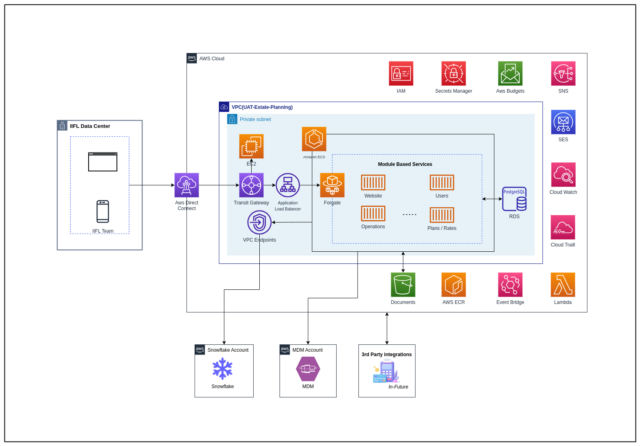
✅ Seamless Cross-Account Data Integration – Connecting MDM and Snowflake databases across AWS accounts via Transit Gateway & VPC Endpoints for secure data exchange.

Approach

The firm’s modernization strategy followed a structured, step-by-step approach:

  1. Infrastructure Assessment & Design

    • Analyzed existing estate planning and financial systems.
    • Designed a secure, scalable AWS cloud architecture with multi-account connectivity.
  2. DevOps & CI/CD Implementation

    • Established GitLab-based CI/CD pipelines for automated deployments and infrastructure management.
    • Integrated Terraform for infrastructure automation and IaC (Infrastructure as Code) best practices.
  3. Advanced Security & Active Directory Integration

    • Deployed AWS Active Directory (AD) to manage user authentication and enforce access controls.
    • Implemented network firewalls, IAM policies, and data encryption to comply with financial regulations.
    • Enabled continuous security monitoring with AWS Security Hub and CloudTrail.
  4. Automation & Cost Optimization

    • Leveraged AWS Lambda for automating start/stop processes for ECS and RDS, reducing cloud expenses.
    • Implemented FinOps strategies to monitor and optimize cloud spending.
  5. Scalability & Elasticity

    • Deployed AWS ECS, Auto Scaling, and Load Balancers to dynamically adjust resources based on demand.
    • Configured multi-region disaster recovery (DR) strategies for high availability.
  6. DevSecOps Implementation

    • Integrated security vulnerability scanning and automated compliance checks into the CI/CD pipeline.
    • Ensured secure container image validation before deployment.
Technologies Implemented

To modernize estate planning and financial operations, the following AWS technologies were deployed:

  • Compute & Scalability: AWS ECS, EC2, Auto Scaling, and Load Balancers.
  • Security & Compliance: AWS Active Directory, IAM, VPC, Security Hub, CloudTrail, and encryption mechanisms.
  • Automation & Cost Optimization: AWS Lambda for ECS/RDS start-stop automation, FinOps for cloud cost efficiency.
  • Data Management & Integration: RDS, S3, MDM, and Snowflake databases connected via Transit Gateway & VPC Endpoints.
  • DevOps & CI/CD: GitLab CI/CD pipelines with Terraform for infrastructure automation.
Architecture:

Benefits Achieved
Enhanced Operational Efficiency
  • Automated estate planning workflows significantly reduced manual effort, allowing staff to focus on high-value tasks.
  • Faster, error-free deployments improved system reliability and service delivery.
Enterprise-Grade Security & Compliance
  • AWS Active Directory enforced centralized authentication, preventing unauthorized access to estate planning data.
  • Stringent IAM controls, encryption, and compliance frameworks ensured regulatory adherence.
  • Real-time security monitoring enhanced threat detection and response capabilities.
Scalability & Elasticity
  • AWS ECS, Auto Scaling, and RDS allowed seamless workload scaling to meet growing demands.
  • The infrastructure adapted dynamically to fluctuating financial transaction loads.
Seamless Data Management & Integration
  • MDM & Snowflake integration enabled secure cross-account data handling.
  • Real-time financial insights improved estate planning decision-making.
Cost Optimization & Cloud Efficiency
  • AWS Lambda automation reduced cloud costs by 35% through optimized resource utilization.
  • FinOps best practices ensured budget control and predictable cloud spending.
Secure, Automated, & Reliable Deployments
  • DevSecOps integration minimized security vulnerabilities in deployments.
  • Reduced manual errors, ensuring high-quality software releases.
Conclusion

By embracing AWS cloud transformation and DevOps best practices, the Asset Management Firm successfully modernized its estate planning and financial operations.

The implementation of DevSecOps, automation, AWS Active Directory authentication, and FinOps strategies reinforced security, scalability, and cost efficiency, ensuring regulatory compliance and seamless financial data management.

With a secure, scalable, and fully automated cloud infrastructure, the firm is now well-equipped to drive innovation, sustain growth, and deliver exceptional value to its clients. 🚀

Introduction

One of the leading players in India’s stock broking industry, this firm is dedicated to empowering investments and securing financial futures. Offering comprehensive investment and trading solutions, the company has built a strong reputation for its expertise. As the business expanded, its legacy on-premises infrastructure became a bottleneck, limiting scalability, increasing operational costs, and slowing down feature deployment. To overcome these challenges, the firm decided to modernize its infrastructure by migrating to AWS, leveraging automation and cloud-native solutions to enhance performance, scalability, and cost efficiency.

Requirements

One of India’s top stock brokers required a robust, scalable, and cost-effective cloud solution that could:

  • Handle fluctuating market traffic efficiently.
  • Improve resource management and scalability.
  • Automate deployments for faster and more reliable releases.
  • Optimize costs while maintaining high performance.
  • Implement monitoring and alerting for proactive management.
Challenges

One of India’s top stock brokers faced multiple challenges with its legacy infrastructure, including:

  • Scalability Issues: The on-premises setup struggled to handle peak trading hours, leading to performance bottlenecks.
  • High Costs: Running all workloads on EC2 instances resulted in excessive operational expenses.
  • Inefficient Resource Management: Manual scaling and resource allocation led to inefficiencies.
  • Slow Deployment Process: Lack of automation slowed down the release cycle, affecting business agility.
  • Monitoring & Alerting Gaps: Limited visibility into infrastructure health impacted proactive issue resolution.
Solution

To address these challenges, One of India’s top stock brokers adopted a cloud-native approach by migrating to AWS. The key solutions implemented included:

  • AWS EKS (Elastic Kubernetes Service) to run containerized applications with automated scaling.
  • Application Load Balancer (ALB) Ingress Controller to expose resources securely.
  • AWS Lambda to automate infrastructure downscaling aftermarket hours, reducing costs.
  • Terraform for Infrastructure as Code (IaC) to automate resource provisioning.
  • GitLab CI/CD Pipeline to streamline and automate deployments.
  • Amazon RDS for efficient and managed database services.
  • Amazon ECR to securely store and manage container images.
  • AWS CloudWatch for real-time monitoring with alerts configured for database instances.
  • AWS IAM (Identity and Access Management) for role-based access control and enhanced security.
  • AWS Budget Alerts to track and optimize cloud costs.
  • AWS EventBridge for automating event-driven actions across AWS services.
  • AWS CloudTrail for auditing and tracking API activity for security and compliance.
Approach
  • Assessment & Planning:

    • Evaluated the existing on-premises setup and identified key bottlenecks.
    • Designed an optimized AWS architecture tailored for scalability and cost efficiency.
  • Migration to AWS:

    • Shifted workloads from EC2 instances to AWS EKS, leveraging Kubernetes’ scalability.
    • Implemented ALB ingress for efficient traffic routing and secure exposure of services.
  • Automation & Optimization:

    • Used Terraform to automate infrastructure provisioning and ensure consistency.
    • Integrated GitLab CI/CD for rapid and reliable deployment cycles.
    • Implemented AWS Lambda functions to scale down non-essential resources post-market hours.
  • Monitoring & Security:

    • Configured AWS CloudWatch for real-time monitoring and alerting on infrastructure health.
    • Implemented IAM best practices for secure access management.
Services Implemented
  • AWS EKS – Managed Kubernetes cluster for scalable container orchestration.
  • AWS ALB Ingress Controller – For exposing services securely and efficiently.
  • AWS Lambda – Automated infrastructure downscaling for cost efficiency.
  • Terraform – Infrastructure as Code for automated provisioning.
  • GitLab CI/CD – Automated deployment pipeline for faster releases.
  • Amazon RDS – Managed relational database service for high availability.
  • Amazon ECR – Secure, scalable container registry for Docker images.
  • AWS CloudWatch – Real-time monitoring and alerting.
  • AWS IAM – Role-based access control and security policy management.
  • AWS Budget Alerts – Cost monitoring and optimization tool.
  • AWS EventBridge – Event-driven automation and orchestration.
  • AWS CloudTrail – API activity tracking and security auditing.
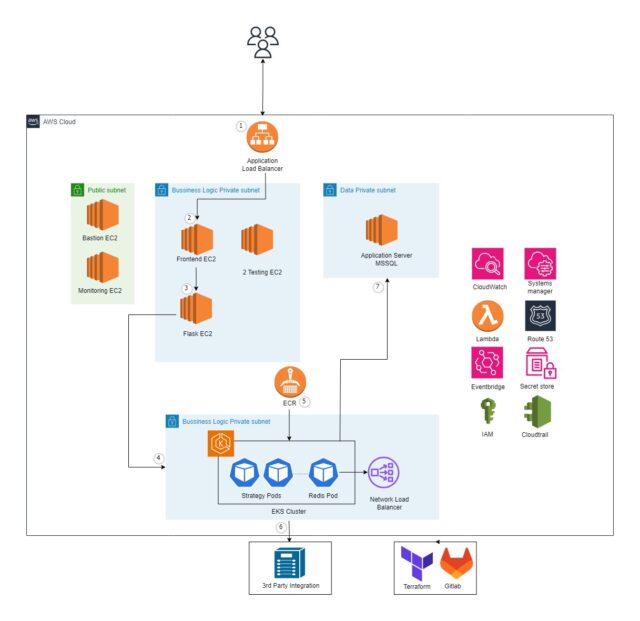
Architecture:

Benefits Achieved
  • 45% Cost Reduction: Migrating from EC2 to AWS EKS significantly optimized costs.
  • Seamless Scalability: Kubernetes autoscaling ensured optimal performance during peak trading hours.
  • Faster Deployment: CI/CD pipeline reduced deployment time and improved release cycles.
  • Improved Resource Efficiency: Automated downscaling of infrastructure minimized unnecessary resource usage.
  • Enhanced Monitoring & Security: CloudWatch provided real-time insights, enabling proactive issue resolution.
Conclusion

By modernizing its infrastructure with AWS, One of India’s top stock brokers successfully overcame the limitations of its legacy setup. The adoption of Kubernetes, automation, and cloud-native solutions resulted in better scalability, cost efficiency, and operational agility. This transformation not only optimized current infrastructure but also positioned the company for future growth and innovation in the stock brokerage industry.

Introduction:

This case study explores the experience of a fictitious company that sought to improve its cloud infrastructure by undergoing an AWS Well-Architected Review. The objective was to identify and address potential vulnerabilities, optimize costs, enhance performance, and align with best practices to ensure a robust and efficient cloud environment.

Requirements:

The company in question is a mid-sized e-commerce platform that has experienced rapid growth in recent years. With an increasingly large customer base and expanding product catalog, the company migrated its entire infrastructure to Amazon Web Services (AWS) to leverage the scalability and flexibility offered by the cloud.

Challenges:

The company faced several challenges in its cloud infrastructure journey:

  • Security Concerns: While the company acknowledged the importance of securing customer data, it needed to ensure its AWS environment aligned with best security practices. There was a need to identify potential vulnerabilities and implement measures to mitigate risks.
  • Cost Optimization: While leveraging AWS for scalability, the company expressed concerns regarding the escalating infrastructure costs. It was crucial to identify cost-saving opportunities without compromising performance and reliability.
  • Operational Excellence: Managing a growing infrastructure efficiently required improvements in operational processes. The company aimed to automate routine tasks and enhance resource utilization to maximize efficiency.
Solution:

The company enlisted AWS experts to perform a thorough Well-Architected Review, focusing on key areas such as:

  • Security Enhancement: The AWS Well-Architected Framework helped identify security risks, including improperly configured permissions and exposed resources. Recommendations included implementing AWS Identity and Access Management (IAM) best practices and regularly reviewing security groups and network access controls.
  • Cost Optimization: Through an analysis of the company’s AWS bills and usage patterns, cost optimization opportunities were identified. The review recommended rightsizing underutilized instances, utilizing reserved instances, and exploring AWS Cost Explorer for more granular cost visibility.
  • Reliability Improvements: The review assessed the company’s system availability and recommended improvements, including multi-region deployments and automated failover strategies for critical services.
  • Performance Efficiency: To enhance performance, the review recommended optimizing database queries, leveraging AWS Elastic Load Balancing for traffic distribution, and exploring Amazon CloudFront for content delivery.
  • Operational Excellence: Automation was a key focus area, with recommendations to implement AWS Lambda functions for event-driven tasks, utilize AWS Systems Manager for patch management, and establish clear operational runbooks.
The Approach:

The company collaborated closely with AWS experts to conduct a comprehensive assessment of its cloud infrastructure. This involved:

  • Engaging stakeholders to understand business objectives and priorities.
  • Conducting thorough evaluations across key pillars of the AWS Well-Architected Framework.
  • Identifying areas of improvement and formulating actionable recommendations.
  • Implementing changes in a phased approach to minimize disruption and maximize impact.
Benefits Achieved:

Following the AWS Well-Architected Review, the company implemented a series of changes and improvements based on the recommendations:

  • Strengthened security measures by updating IAM policies and conducting regular security audits.
  • Cost optimization initiatives resulted in a significant reduction in monthly AWS bills without compromising performance.
  • Enhanced reliability by implementing multi-region failover strategies.
  • Realized performance improvements through optimizing database queries and enhancing content delivery.
  • Achieved operational excellence by automating routine tasks and creating comprehensive runbooks.
Conclusion:

AWS Well-Architected Review, the fictitious company effectively addressed security concerns, optimized costs, improved reliability, enhanced performance, and achieved operational excellence.

Introduction:

Our client, a prominent technology firm in the industry, faced significant challenges with cloud cost management. As their cloud infrastructure expanded, they recognized the need to optimize costs. This was crucial for maintaining profitability. They also aimed for operational efficiency. Our FinOps consulting services were engaged to address these challenges.

Requirements:
  • Reduce cloud costs while simultaneously maintaining or improving system performance and reliability.
  • Gain better visibility into cloud spending and allocate costs accurately to different teams and projects.
  • Implement a proactive cost management strategy to prevent budget overruns.
  • Ensure that cost optimization measures do not compromise the availability and performance of critical services.
Challenges:
  • Lack of visibility: The client had limited visibility into their cloud spending, making it difficult to identify areas of waste or inefficiency.
  • Uncontrolled resource provisioning: Teams were provisioning cloud resources without clear guidelines, resulting in over-provisioning and underutilization.
  • Complexity of cost allocation: The client struggled to accurately allocate cloud costs to various teams and projects, making it challenging to hold teams accountable for their spending.
  • Fear of service disruption: There was a concern that implementing cost optimization measures might disrupt critical services or compromise performance.
Solution:
  • Cost Visibility: We implemented a robust cloud cost management tool that provided real-time visibility into cloud spending. This tool tracked expenses at the resource level, enabling detailed cost analysis.
  • Tagging Strategy: We worked with the client to develop a comprehensive tagging strategy for cloud resources. This strategy allowed for accurate cost allocation to different departments and projects.
  • Rightsizing Resources: We conducted a thorough resource utilization analysis and identified instances that were over-provisioned. By right-sizing instances and adopting auto-scaling policies, we achieved significant cost reductions without sacrificing performance.
  • Reserved Instances: We recommended purchasing Reserved Instances for stable workloads, ensuring cost savings through long-term commitments.
  • Spot Instances: For non-critical workloads, we strategically implemented the utilization of spot instances, significantly reducing costs while maintaining reliability.
  • Budgeting and Alerts: We assisted the client in establishing budgets for various departments and projects, with automated alerts triggered when spending approached or exceeded budgeted limits.
The Approach:
  • Assessment: We conducted an initial assessment of the client’s cloud infrastructure, spending patterns, and resource utilization.
  • Tagging Strategy: We collaborated closely with the client’s IT and finance teams to develop and implement a robust tagging strategy.
  • Rightsizing and Optimization: We performed a comprehensive analysis of resource utilization and identified opportunities for cost reduction through rightsizing, reservation, and spot instances.
  • Training: We provided FinOps training to the client’s teams to ensure they understood the new cost management practices and how their actions could impact cloud spending.
  • Monitoring and Continuous Improvement: We established continuous monitoring and regular reporting to track progress in cost optimization and identify areas for further improvement.
Benefits Achieved:
  • Significant Cost Reductions: Achieved a 30% reduction in monthly cloud expenses over six months.
  • Improved Visibility and Control: The company now has better control over cloud spending and accurate cost allocation.
  • Proactive Cost Management: Implemented a proactive cost management strategy to prevent budget overruns.
  • Maintained Performance and Reliability: Ensured that cost optimization measures did not compromise the availability and performance of critical services.
Conclusion:

By implementing cost visibility, tagging, rightsizing, and budgeting strategies, our client achieved significant cost reductions. This improved their cloud operations. Over a span of six months, they achieved a 30% reduction in monthly cloud expenses, all while maintaining system performance and reliability. The company now has better control over cloud spending, accurate cost allocation, and a proactive cost management strategy in place. This case study demonstrates how effective FinOps practices lead to substantial cost savings. They also enhance operational efficiency for organizations using cloud services.